





Chris Hopper is an excellent choice when you’re looking for an expert on the differences between the German and US photovoltaic markets. Not only because his company, Aurora Solar, has been offering planning software to installers in Germany, Austria, and Switzerland since 2023, following its great success in its home market, but also because Hopper is a native of Munich. He went to England to study electrical engineering, followed by several years in the off-grid solar industry and smaller projects in Africa. In the US, he met Samuel Adeyomo, with whom he founded Aurora Solar in 2013. The story reads like a classic entrepreneurial tale: The two initially wanted to install photovoltaic systems and were looking for good planning software. Since they couldn’t find any, they developed their own.
Eleven years later – in April 2024 – Aurora Solar reported having surpassed the 20 million mark for planned photovoltaic projects. However, this doesn’t mean the company had nothing left to learn when entering the DACH region – Germany, Austria, and Switzerland. This is not only due to the presence of established competition in the planning software market, but also because the photovoltaic market as a whole is different.
pv magazine: The pace at which Aurora Solar grew in the US was truly gigantic. As far as we can tell, it’s not growing nearly as fast here in Germany. Is that a correct observation, and if so, what are the reasons for it?
Chris Hopper: I’d say it depends on the timeframe. For the first few years, we didn’t grow quickly in the US either. Initially, it was about understanding the market and adapting the product. We’re in a similar phase now in Germany. We’ve already learned a lot, but it simply takes time if you want to do it properly. However, I think things are going well for the phase we’re in now: lots of customer conversations, a lot of product development, and learning. At some point, it will all come together, and then the scaling phase will begin.
What did Aurora have to learn here in Germany? Our impression is that the software is technically state-of-the-art.
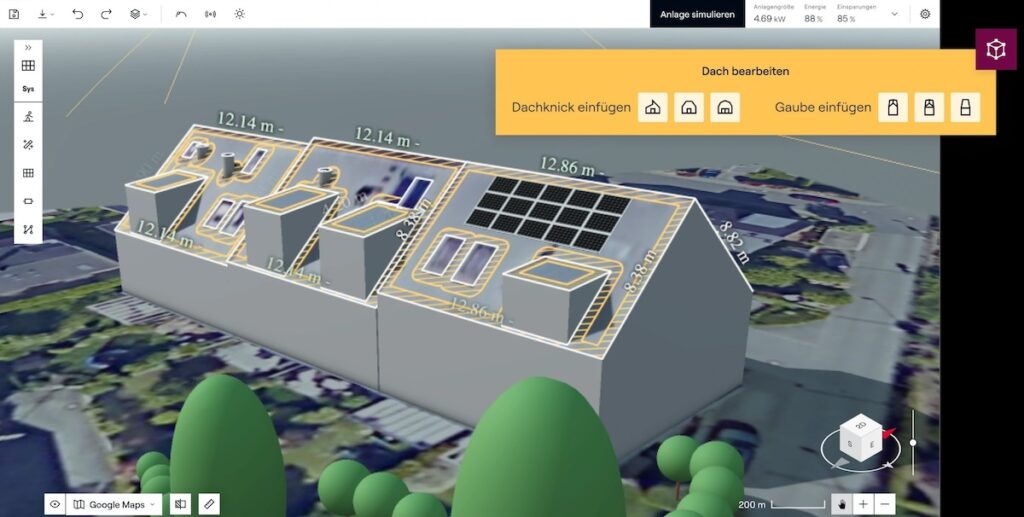
I essentially agree with the statement. I don’t know of any other product on the market that can do everything ours can. But when it comes to the benefits for solar installers, details are important, for example, regarding the data. Because we work with satellite and lidar data, it was crucial to have good data sources for a new market. Another issue: Our AI, which automatically creates house models, was naturally trained on American datasets and American roofs. Terraced houses, for example, are important in Germany, but hardly at all in the US. So how do we model terraced houses? It’s all doable, but it’s also an example of how you have to adapt the product to a new market. Storage, another issue, is significantly more important in the German market than in the American one. It’s becoming increasingly important there as well, but here it’s already a central component. Or take the wiring diagram: German solar installers expect software to create it automatically. That’s not as important for Americans because their process is different. We had to integrate all of this into our product to meet the demands of the German market.
Isn’t there a different customer structure in Germany, specifically among installation companies? We have a high proportion of smaller companies here, with up to about ten employees. At least that’s our impression, they don’t play such a significant role in the US market.
There are many small companies there too, but it’s true that the larger ones have a bigger share of the market volume. However, the small companies were also a reason why my co-founder Samuel Adeyemo and I started Aurora Solar in 2013. Initially, we thought we’d build systems and simply buy the planning software that other installers were using. Then we saw that the large installation companies had developed their own in-house software. While that wasn’t exactly what we had envisioned, the small and medium-sized companies simply had nothing. A small business can’t develop its own planning software. Therefore, it has always been part of our philosophy to provide best-in-class tools for the entire market, for large companies as well as small ones. And even though the small business segment in the US isn’t necessarily the largest, it’s something we care deeply about.
For small businesses, it can be quite difficult to learn a new, feature-rich software. There’s a tendency to say, “The software we use might not be perfect, but we know it, so we’ll stick with it.” Isn’t it very difficult for Aurora Solar’s sales team to convince so many small businesses?
For smaller businesses, we tend to follow a self-service approach, where people access the website themselves and register. If they have any questions, they can, of course, ask them. That’s how we did it in the US as well. Our direct sales focus is more on medium-sized and larger companies. Otherwise, we wouldn’t be able to offer the product at a price point that would also appeal to small businesses.
The German solar industry is currently quite unsettled because the federal government is talking about subsidy cuts, particularly for small rooftop installations, and about slowing down the expansion of new capacity. How does Aurora Solar perceive this, especially in comparison to what’s happening in the USA?
This is an example of what I mean when I say: If I look from the US to Germany, I’m looking at the future from the perspective of the photovoltaic market. In every market where solar power has reached a certain share, the question eventually arises: It’s volatile, dependent on the weather, and so on – so how do you plan the grid and how do you keep it stable? It’s all solvable, but we as an industry have to provide answers: How do we achieve this, how do we reduce costs, how do we design the systems so that they comply with all requirements?
We’ve been talking about “the” US market, even though it doesn’t really exist as a single entity. There’s a huge difference between being in Oregon, California, or other states. Is the entire expansion of photovoltaic capacity in the US truly at risk due to the so-called One Big Beautiful Bill, or are there still significant regional differences between the individual states?
There are always big differences between the states. Hawaii, for example, is a pioneer; it has very high electricity prices. There have always been many photovoltaic systems there, and they were also the first to face the problem of having too much solar power. In California, of course, in large areas of the northeast, but also in Texas and Arizona, for example, there is a lot of photovoltaics. In contrast, Washington State, for example, has much less sun, but also much more hydropower and lower electricity prices. It really always depends on the balance. The more expensive the electricity prices, the better for solar systems; the more sun, the better. Subsidies are also important. But this balance varies greatly from state to state.
“One can live with the One Big Beautiful Bill.”
The One Big Beautiful Bill wasn’t so beautiful for the solar industry, unfortunately – but probably not as bad as it initially seemed. I think we can live with it. Regarding tax refunds through the Investment Tax Credit, there’s currently one option for end customers and one for businesses. The one for end customers will be discontinued in January. But the other option remains and is used for things like PPA projects, but also for leasing. This will shift the market for smaller systems. People will buy fewer solar panels outright or finance them with loans – and lease more instead. The market will initially shrink because everything has to adjust. But I believe it will grow again afterward; the forecast for the next five to ten years is around 15 to 18 percent per year. Electricity costs are still rising, while electricity consumption is increasing. And on the other hand, the costs for solar continue to fall, especially for storage. These are all forces that will drive the market forward in the medium and long term.
It’s noticeable that photovoltaic systems are significantly more expensive in the US than in Germany. Import tariffs alone can’t account for this, as the price differences existed before. Is it primarily due to labor costs, or are there structural reasons at play?
There are several reasons. Partly it’s labor costs, but that also varies from state to state. In California, for example, a system costs 80 cents more per watt than in Arizona. Another factor is financing costs; Americans tend to finance such purchases. Unfortunately, the permitting process is often very complex and not standardized. This, of course, depends heavily on the state, often on the specific city, or even on the individual official. It’s all very inconsistent and incurs additional costs.
And then, I think, customers in the US aren’t as familiar with solar power. German customers have been hearing about it for ten years now; they know about it from their neighbors. They have a pretty good understanding of how it all works, whereas the average American usually doesn’t. That’s why in the US, systems are sold more often than purchased – you can’t rely on existing demand, but have to actively market the systems to customers. The costs of customer acquisition are very high.
These are the main reasons why it ends up being significantly more expensive. Customs duties are now added on top, although this isn’t a major problem for small orders, as the hardware accounts for less than half of the total price.
Are Europe, and especially the German market, then a kind of counter-model because they are further ahead in areas such as integration, regulation, and social acceptance? Could the USA learn from this?
I think so. In Germany, there’s a more unified opinion in society and politics than in the US. There, the Democrats are for it and the Republicans are against it. That’s naturally a problem for the industry when politics is constantly shifting back and forth. Sometimes the substance gets lost, and there’s no objective assessment: What is our energy mix, what role does the solar industry play today, and what role can it play tomorrow? And then, as already mentioned, there are the end customers: The more knowledgeable an end customer is about the system, the more involved they can be in the purchasing process, and that can reduce costs. Germany is simply far ahead in this respect.
But even though many end customers in Germany have grasped how grid feed-in works, it has become significantly more complex. First came self-consumption, then battery storage, perhaps a wallbox and heat pump, all controlled by an energy management system. Isn’t the trend shifting back towards customers saying: “I don’t really understand how it works and therefore have to trust that the installer understands it and can advise me?”
Yes, it’s true that the whole thing is becoming more complex. But the German market is ahead in this respect as well. In the US, they’re only just entering the “solar plus storage” phase, and there’s little discussion about what else might be added – heat pumps perhaps, and surprisingly, wallboxes are less of a topic in the US.
“The winner takes most.”
So I do expect the amount of consultation required to increase, but I also hope that the end customer will adapt and learn over time. Eventually, storage costs, for example, will fall even further, and then it won’t be quite so crucial that everything is a 100% perfect fit in terms of size – 80% will suffice, and the costs will still be reasonable. But generally speaking, yes, there will be more complexity, and that’s another reason why I believe planning software is so important. The customer needs to trust the installer, but the installer also needs the tools to make the right decisions.
If an installer uses software like Aurora’s, which is quite complex and offers a wide range of capabilities, won’t the effect be greater that they say: “I have this software, and I’m sticking with it”? And might the software developers eventually say: “We have our customers, they’re sticking with our product, so we don’t need to improve it much anymore”?
It would be nice if we didn’t have to do much anymore. No, seriously: Our customers keep us on our toes. We get direct feedback from them about their requirements. And of course, we have to keep up. That’s also one reason why we have so many employees in development alone. Sometimes the question comes up: Why do you have so many people there? Isn’t your product finished yet? But firstly, a product like this is never truly finished. And secondly, our market is simply very dynamic and also has different requirements depending on the region.
The principle “The winner takes it all”, which is often the case in the software and IT sector and according to which one company eventually dominates the market and all others only occupy niches, does not apply to solar planning software?
“The winner takes most,” perhaps. In the States, we managed to become the market leader quite well. But we achieved that through a product that was simply better than the competition. That, of course, brought more people to our platform. And with that, we generated more revenue, which in turn allowed us to hire more developers who then further improved the product, and that, in turn, brought us even more customers.
That’s how we did it in the US, and we naturally hope to establish ourselves as the market leader in Germany as well. We have a core product that allows us to bring significant value to the German market. Incidentally, there is one area where the US is ahead of Germany: digital processes. And we hope that we can now bring what we’ve learned about digital processes in the US to Germany, while – very importantly – also addressing the specific needs of the German market. And that we can establish ourselves as the market leader here on this basis as well.
We wish them the best of luck. But as journalists, we also wish everyone else the best of luck, so that it will be an exciting competition.
I agree. Of course, we have to prove ourselves through our product, and if another product has better features, we have to catch up. And that’s good for the market. Ultimately, the market has to be successful, and we have to work together to ensure it grows and adapts to new demands. That’s something bigger than just us.
This content is protected by copyright and may not be reused. If you want to cooperate with us and would like to reuse some of our content, please contact: editors@pv-magazine.com.





The U.S. by and large are not ready for Solar Applications because of ignorance, laziness and worst of all Greed. A very good method of measuring intelligence and foresight in electorate. The Space Race exploded our technological endeavors and advancement. The Apollo Program depended more on fuel cells rather than Solar Power. Now, ISS depends almost exclusively on Solar applications. I have heated my hot water for 37 years mostly exclusively in summer and augmented in winter by solar roof mounted collectors. Solar Voltaic Technologies have exploded and now offers off-grid independence a reality even at modest prices in many places around the globe. Germany struggled with independence from Russian or Mid-East Oil has increased demand for renewable generated electrical needs. Keep up good work. Thank You , wlr