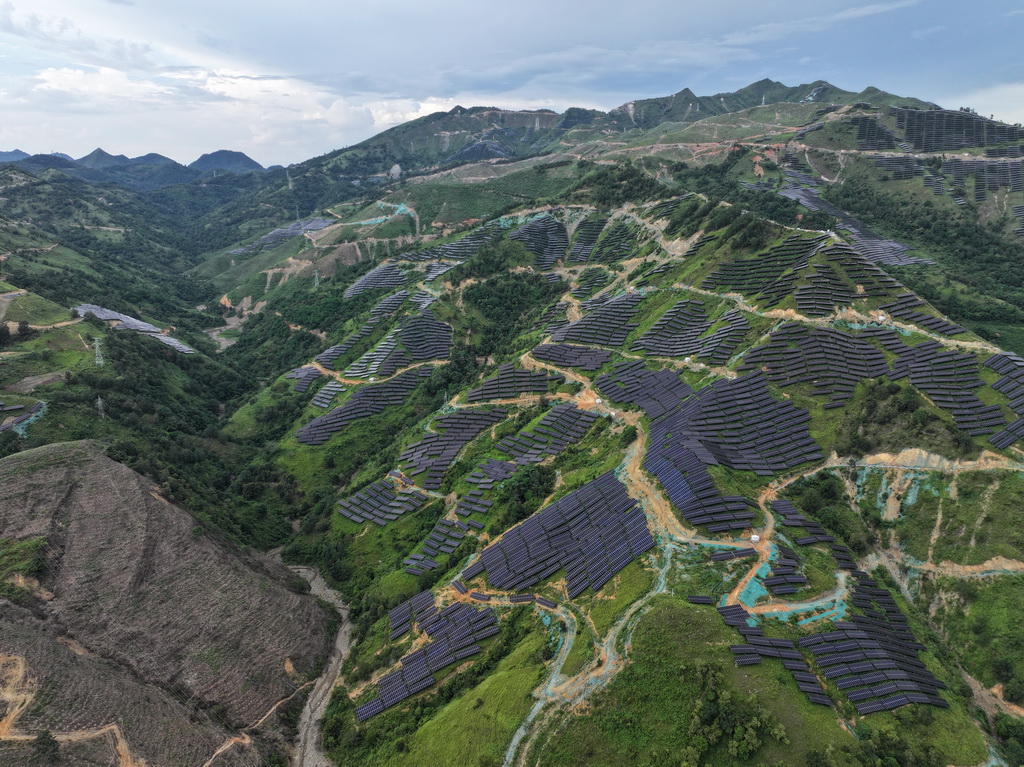





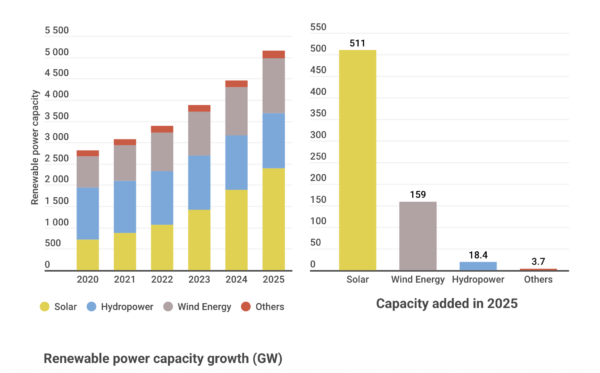
A total 511 GW of solar was added globally across 2025, according to the latest report from the International Renewable Energy Agency (IRENA).
IRENA’s Renewable capacity statistics 2026 finds solar energy remained the fastest-growing source of renewable energy last year, accounting for around 75% of the 692 GW of renewables added worldwide in 2025.
The figures represent a record in a calendar year for both global solar deployments and total renewables deployment, outperforming the previous 452 GW of solar and 585 GW of renewables records featured in last year’s equivalent report.
Total worldwide renewable power capacity reached 5.14 TW by the end of 2025, IRENA’s report adds, equivalent to 49% of global installed power capacity, with solar accounting for around 2.4 TW of the total.
Renewable energy accounted for an 85.6% share of all power capacity expansion worldwide in 2025, down on the 92.5% quoted in IRENA’s report last year.
Asia continued to lead renewables deployment in 2025 with a 74.2% contribution to all new renewable capacity, while both Africa and the Middle East recorded their largest annual growth in renewables deployment to date, increasing by 15.9% and 28.9% year-on-year respectively.
Uptake was slower in other parts of the world, with Central America and the Caribbean recording the lowest renewables capacity with a total 21 GW in 2025. IRENA says this disparity exposes the vulnerability of economies with low share of renewables and underscores the urgent need to increase the share for their energy security.
The agency adds that with escalation in the Middle East raising fresh concerns over supply security and fossil fuel price volatility, increasing the share of renewable energy in national energy systems can help to reduce countries exposure to international fuel markets.
IRENA Director-General, Francesco La Camera, commented that renewable energy remains consistent and steadfast in its expansion in the midst of uncertain times, indicating both market preference and a strong case for renewable energy resilience. In the report’s forward, he added that the world needs to see a much faster pace of growth in the stock of renewable power plants and distributed electricity generation.
“A more decentralized energy system, with a growing share of renewables and more market players, is structurally more resilient,” La Camera explained. “Countries that invested in the energy transition are weathering this crisis with less economic damage, as they boost energy security, resilience and competitiveness.”
This content is protected by copyright and may not be reused. If you want to cooperate with us and would like to reuse some of our content, please contact: editors@pv-magazine.com.




By submitting this form you agree to pv magazine using your data for the purposes of publishing your comment.
Your personal data will only be disclosed or otherwise transmitted to third parties for the purposes of spam filtering or if this is necessary for technical maintenance of the website. Any other transfer to third parties will not take place unless this is justified on the basis of applicable data protection regulations or if pv magazine is legally obliged to do so.
You may revoke this consent at any time with effect for the future, in which case your personal data will be deleted immediately. Otherwise, your data will be deleted if pv magazine has processed your request or the purpose of data storage is fulfilled.
Further information on data privacy can be found in our Data Protection Policy.