





The United States is at an inflection point and, according to Britt Zwierzchowski-Tisler, chief operating officer of the Conservative Energy Network (CEN), “we’re missing some of the more critical arguments in favor of onshoring that supply chain.”
The COO moderated a recent webinar with U.S. solar manufacturing thought leaders to discuss strategies for achieving clean energy goals, given the current geopolitical economic climate.
Participants included Mike Carr, executive director of the Solar Energy Manufacturers for America Coalition (SEMA), Danielle Russo, executive director of the Center for Good Security at Safe, and Jade Jones, senior director, solar products manufacturing and supply chain for the Solar Energy Industries Association (SEIA).
Domestic manufacturing is critically important now because the global market is already selecting solar, Carr said, yet it’s being selected at a time when a trading adversary has worked hard to dominate. Carr also pointed out that we’re in a time of great electrification and not just in manufacturing but in a lot of aspects of society.
Carr alluded to the OPEC energy crisis of 1973 that sent oil prices skyrocketing and warned that to meet today’s new needs it’s critical that “we don’t yield that sort of hammerlock over this critical resource to an adversarial country.”
In addition to energy security, energy is foundational to many industries, said Jones, who noted that Grid Strategies estimates that electricity usage is forecast to grow by 5.7 % annually over the next five years. “This really contrasts what it was the prior two decades where it was under 1%,” she said.
To meet the growing electricity demand, solar deployment is critical, Jones stated. Solar is the fastest deployed generating technology, and it’s also the largest source of new generating capacity, accounting for over 50% of new electric generating capacity in the past three years, Jones added.
“Speed is kind of that foundational ingredient that we need to solve a lot of our energy problems,” Russo said. While Russo sees it as essential to lean into the fastest options, she warned that the U.S. should “make sure we don’t go from an over-leveraged non-peer adversary in Iran to an over-leveraged peer adversary in China.”
The domestic solar industry plays a unique, important role in helping the United States achieve the necessary speed of deployment, Russo noted.
Domestic content
The current state of U.S. solar manufacturing is an exciting story, Jones said. Solar manufacturing is taking place in 43 states and Puerto Rico, and she noted that for some solar products, domestic capacity is sufficient to meet domestic demand.
“There are gaps upstream, but upstream manufacturing buildout typically follows downstream build out,” said Jones. She said continued growth is contingent on more policy and market certainty, and noted that only three other country markets have scaled solar product manufacturing in the same way as the United States.
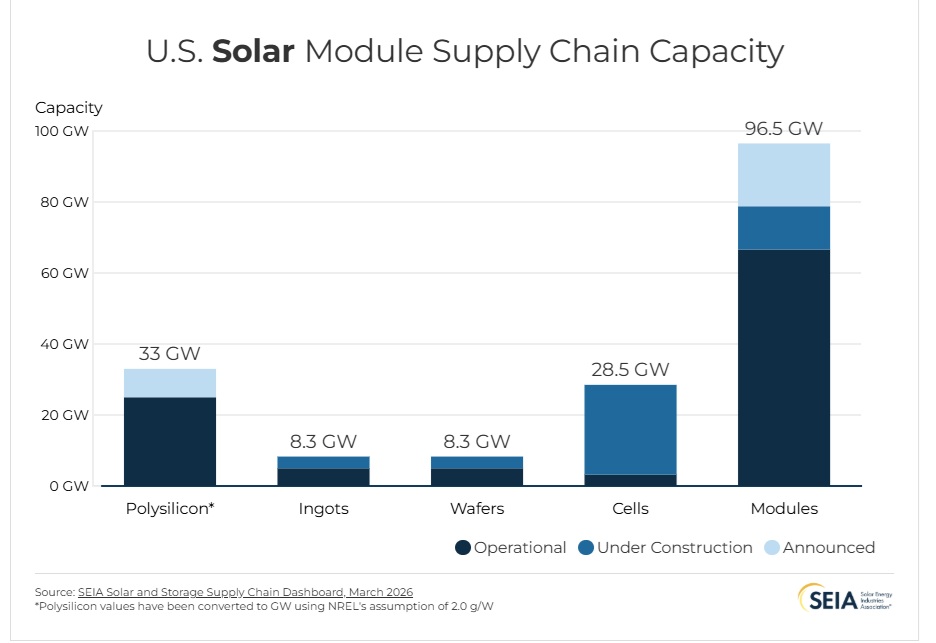
“I think something that is underappreciated is solar projects are showing up with an increasing amount of domestically produced U.S. solar products as manufacturing has scaled,” Jones said.
To keep U.S. solar manufacturing moving forward, “certainty is king,” Carr said. He pointed out that as manufacturing advances up the supply chain, it gets more expensive and the payback is longer. He said this is why upstream manufacturing is more susceptible to small changes in policy support.
The upstream facilities also demand huge amounts of electricity, Carr noted, and having a common commitment to manufacturing is important. “We are at forefront of making processes clean because we have a robust regulatory structure in the U.S.,” he said. “Lack of transparency can be hugely frustrating especially as you’re looking at multimillion dollar commitments.”
Economics and security
It’s estimated that by 2027, the U.S. solar industry will induce or support over 50,000 American jobs with a capital investment of almost $8 billion, Russo said. But what’s also important, she said, is how the U.S. thinks about domestic solar manufacturing as strategic national security policy. “Solar is one of faster speed-to-grid technologies that we have in our toolbox,” she said, adding that domestic solar is even faster. “National security is a matter of who can make the best decision the fastest to protect themselves. Domestic manufacturing of solar helps us get that edge, Russo concluded.
This content is protected by copyright and may not be reused. If you want to cooperate with us and would like to reuse some of our content, please contact: editors@pv-magazine.com.





By submitting this form you agree to pv magazine using your data for the purposes of publishing your comment.
Your personal data will only be disclosed or otherwise transmitted to third parties for the purposes of spam filtering or if this is necessary for technical maintenance of the website. Any other transfer to third parties will not take place unless this is justified on the basis of applicable data protection regulations or if pv magazine is legally obliged to do so.
You may revoke this consent at any time with effect for the future, in which case your personal data will be deleted immediately. Otherwise, your data will be deleted if pv magazine has processed your request or the purpose of data storage is fulfilled.
Further information on data privacy can be found in our Data Protection Policy.