




In 2019, California predicted a coming energy shortfall during the first half of the 2020s. Turns out, there were multiple outages during record-high demand events. The state also showed that it could deploy energy storage in enough capacity to protect its power grid.
On February 26, 2026, the state voted to address the next perceived energy shortfall, projected to happen sometime in the early 2030’s. The vote began the process of procuring 6 GW of new capacity as part of its Integrated Resource Planning and Long-Term Procurement Planning processes.
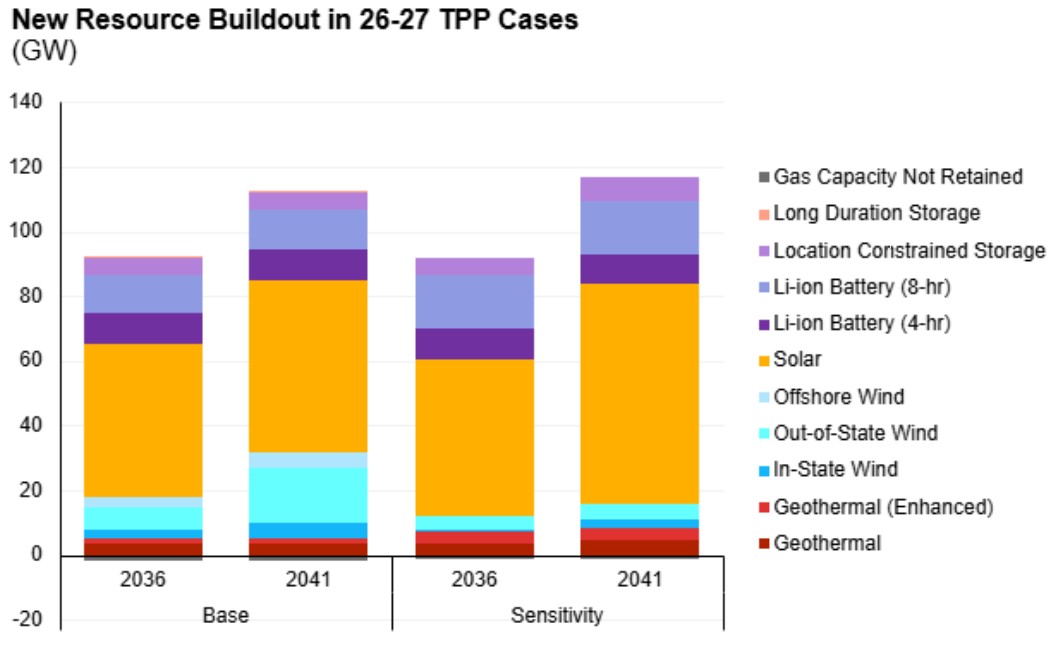
Source – CPUC: Cumulative base projected buildout of new resources, limited wind sensitivity
The CPUC order requires that “local electricity providers procure additional clean energy supply to maintain reliability of the system consistent (proportional) with forecasted demand growth.” In total, the CPUC ordered,
- 2,000 megawatts (MWs) of net qualifying capacity (NQC) by June 2030
- An additional 2,000 MWs NQC by June 2031
- An additional 2,000 MWs NQC by June 2032
Load growth
The CPUC projects approximately 177 TWh of electricity demand growth across California’s 31 unique load serving entities. Southern California Edison, which is the largest by far, accounts for 29% (51 TWh) of the overall growth. At the other end of the spectrum, King City Community Power will need to cover an additional 36 MWh in projected demand.
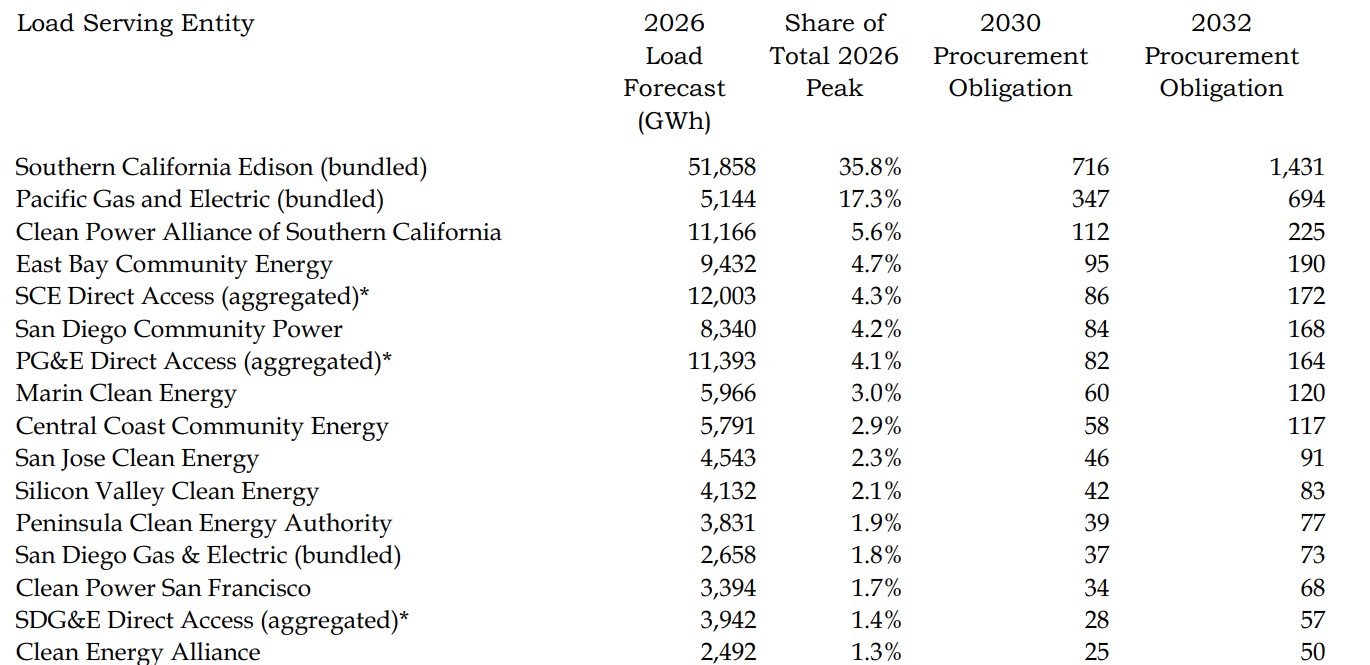
Source – CPUC, partial list of projected 2030 load growth
The procurement volume assigned to each load-serving entity is driven by its unique peak demand growth as opposed to total electricity demand growth.
For instance, Southern California Edison’s 29% share of electricity demand growth translated into 35.8% of peak demand growth. Thus of the 2 GW anticipated to be procured in 2030, 716 MW – 35.8% – must come from Edison. King City Community Power, the smallest entity by peak capacity growth, has a 0.4 MW procurement obligation in 2030, and an additional 1 MW in the two following tranches.
Firm capacity
Capacity under the CPUC order will be rated on its ‘effective load carrying capability’ (ELCC), measured in ‘net qualifying capacity’ (NQC). Determined by both the scaling of ELCC/NQC, a standalone solar plant would be worth about 10% of its AC capacity. This low figure reflects how much daytime solar is already deployed on the grid. In contrast, a four or eight-hour battery is currently rated at 90–95% of its capacity output.
Technically, standalone solar is not even eligible for this procurement.
For example, a 200 MWac solar plant paired with a 100 MW four-hour battery may be rated at approximately 110 MW NQC. This would comprise 20 MW of NQC from the solar, and 90 MW NQC from the battery. The ELCC/NQC values are effectively unrelated to the DC (solar panel) capacity of a solar power plant.
The CPUC projects that solar paired with four-hour energy storage will represent a majority of present and future procurement capacity, while also making room for evolving and emerging technologies.
The final 25% of the procurement is split into two high-capacity-factor categories. The first 750 MW require eight-hour or longer energy storage technologies, which may be co-located with solar. The second 750 MW is reserved for technologies that are neither “use limited nor weather dependent”, which excludes solar and wind. Resources in this category are expected to deliver a capacity factor above 80% over the course of the year.
Long view
Today, the CPUC counts about 25 GW of utility-scale solar deployed in the state. Their projections show about 10 GW of solar capacity being added through the end of 2031, and nearly doubling over 15 years.
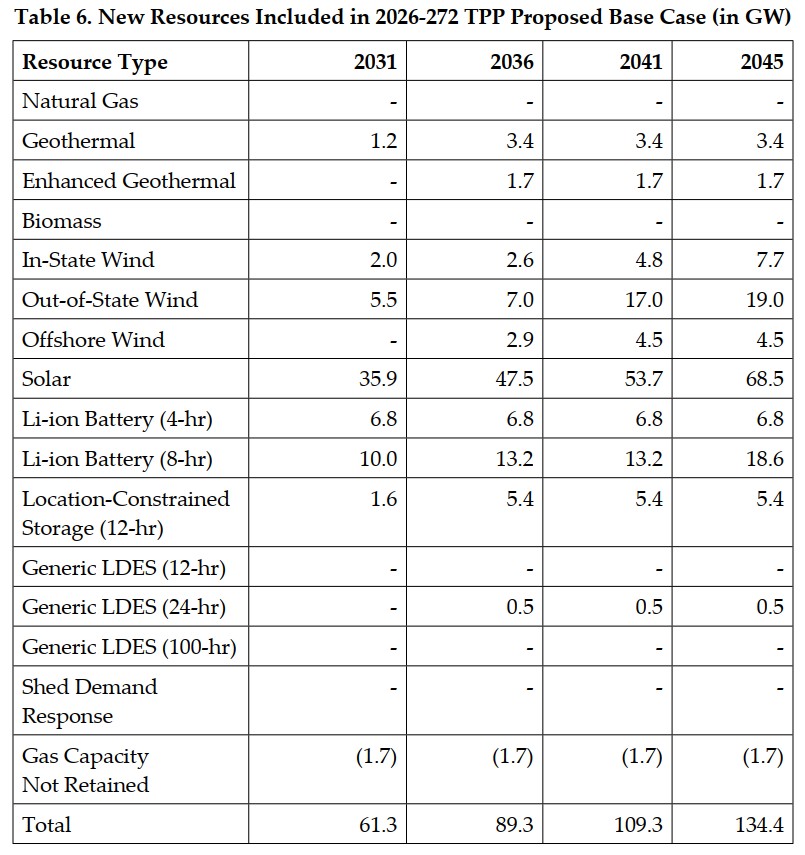
Source – CPUC IRP, capacity projections
Going forward, CPUC projects, solar and storage will dominate California’s future energy landscape. Already, solar is already the state’s largest electricity source.
The next largest electricity sources are expected to come from wind – with out-of-state leading, followed by in-state land-based wind, and then offshore facilities. A modest geothermal contribution is also projected – some of which will likely be part of this 2030 procurement. The projections show no new fossil generation planned.
This content is protected by copyright and may not be reused. If you want to cooperate with us and would like to reuse some of our content, please contact: editors@pv-magazine.com.


By submitting this form you agree to pv magazine using your data for the purposes of publishing your comment.
Your personal data will only be disclosed or otherwise transmitted to third parties for the purposes of spam filtering or if this is necessary for technical maintenance of the website. Any other transfer to third parties will not take place unless this is justified on the basis of applicable data protection regulations or if pv magazine is legally obliged to do so.
You may revoke this consent at any time with effect for the future, in which case your personal data will be deleted immediately. Otherwise, your data will be deleted if pv magazine has processed your request or the purpose of data storage is fulfilled.
Further information on data privacy can be found in our Data Protection Policy.