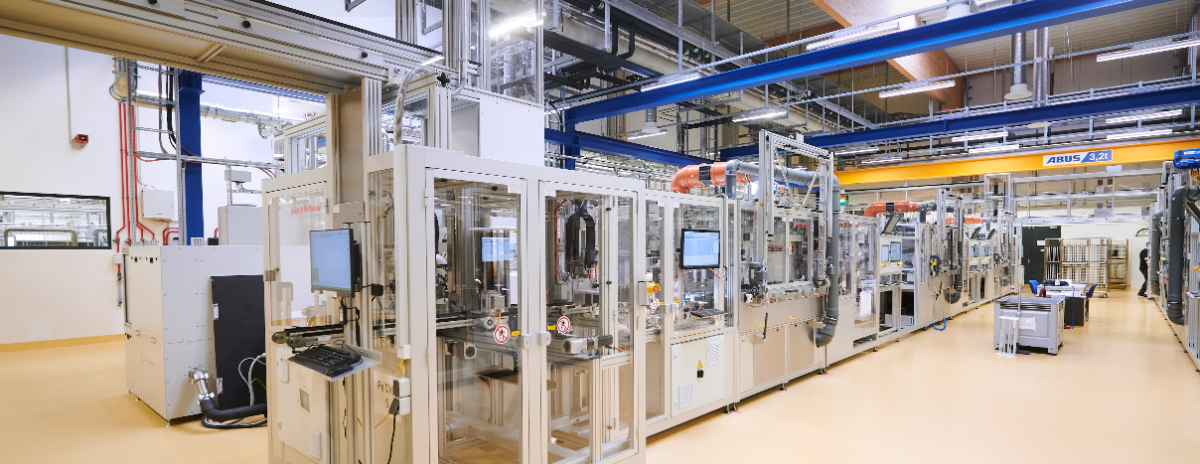





California-based Swift Solar announced the acquisition of core manufacturing assets and the HJT patent portfolio from Swiss firm Meyer Burger. The deal includes the transfer of Meyer Burger’s specialized engineering team and executive leadership to Swift Solar as the company transitions toward gigawatt-scale production in the United States.
The acquisition provides Swift Solar with a vertically integrated path for silicon-perovskite tandem cells. HJT is a high-efficiency silicon cell architecture that serves as the base layer for tandem modules. By stacking perovskite onto an HJT bottom cell, Swift Solar aims to surpass the theoretical efficiency limits of conventional silicon, which currently plateau near 30%.
As part of the transaction, key members of Meyer Burger’s leadership will join Swift Solar. Gunter Erfurt, former CEO of Meyer Burger, and Marcel Koenig, former global head of R&D, will lead the integration of the HJT technology.
The move secures the most extensive HJT intellectual property portfolio in the Western Hemisphere for Swift Solar. This “freedom to operate” is a critical requirement for scaling manufacturing without the litigation risks that have historically impacted investment in the thin-film and high-efficiency solar sectors.
The demand for high-density power is increasing, driven largely by the expansion of AI data centers and broader grid electrification. Swift Solar noted that the acquisition addresses the current bottleneck in the U.S. supply chain: domestic cell manufacturing.
While the U.S. has seen an influx of module assembly plants, solar cell production remains concentrated in Asia. HJT is unique among silicon platforms because its primary manufacturing equipment can be sourced and built outside of China, aligning with current U.S. policy goals regarding domestic content and supply chain security.
Roadmap to commercialization
Swift Solar, which has raised over $60 million from investors and government agencies including the DOE and DOD, plans a phased approach to deployment:
-
HJT scale-up: Establish a gigawatt-scale HJT cell and module factory in the U.S. to meet immediate demand for domestic silicon cells.
-
Tandem integration: Incorporate Swift’s proprietary perovskite technology into the established HJT lines to produce two-terminal tandem cells.
-
Efficiency gains: Leverage the tandem structure to provide up to 40% more power from the same physical footprint compared to standard 20% to 24% efficient modules.
“We are combining German silicon manufacturing expertise with American perovskite technology leadership,” said Joel Jean, chief executive officer of Swift Solar.
The company stated that its tandem products have demonstrated durability over 3,000 hours of high-temperature operation, addressing long-standing industry concerns regarding the field-life of perovskite materials.
This content is protected by copyright and may not be reused. If you want to cooperate with us and would like to reuse some of our content, please contact: editors@pv-magazine.com.








By submitting this form you agree to pv magazine using your data for the purposes of publishing your comment.
Your personal data will only be disclosed or otherwise transmitted to third parties for the purposes of spam filtering or if this is necessary for technical maintenance of the website. Any other transfer to third parties will not take place unless this is justified on the basis of applicable data protection regulations or if pv magazine is legally obliged to do so.
You may revoke this consent at any time with effect for the future, in which case your personal data will be deleted immediately. Otherwise, your data will be deleted if pv magazine has processed your request or the purpose of data storage is fulfilled.
Further information on data privacy can be found in our Data Protection Policy.