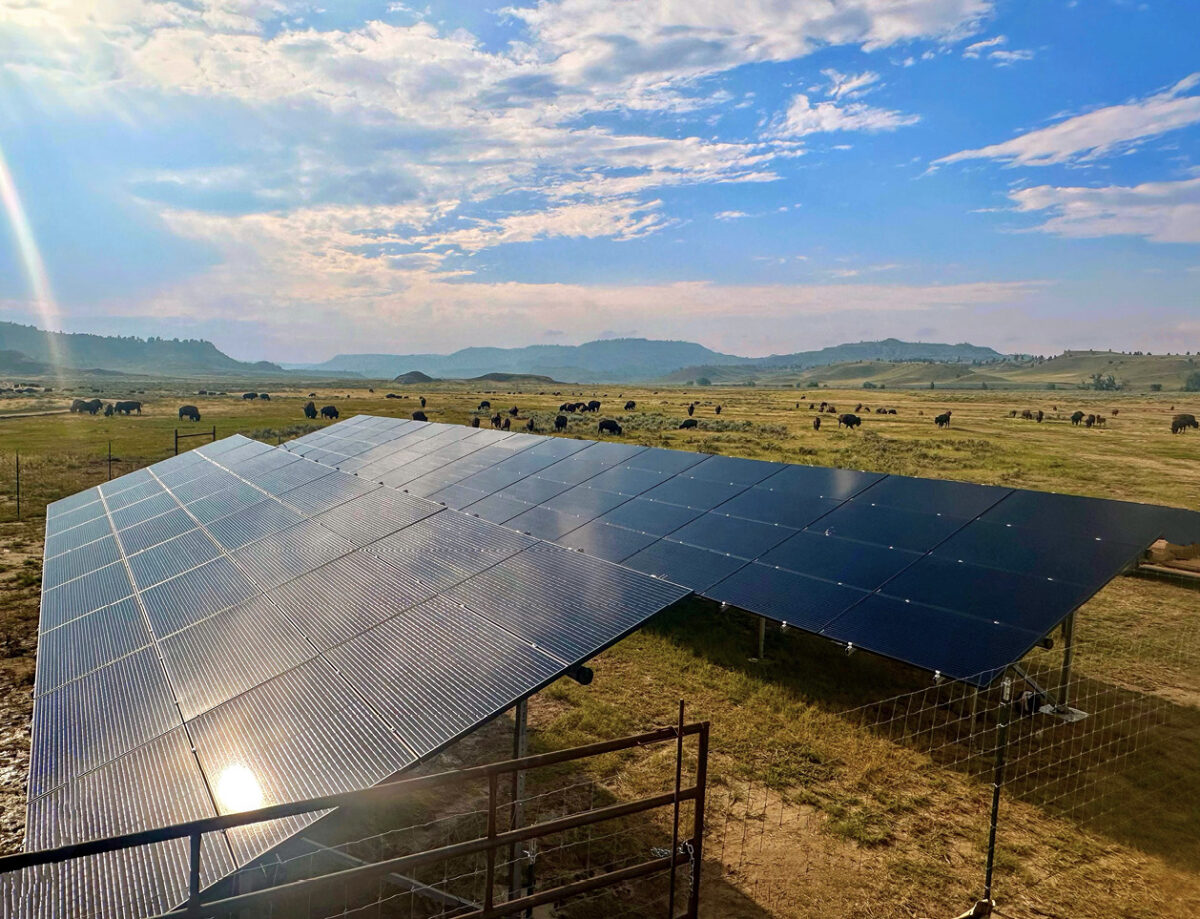





In southeastern Montana, the Northern Cheyenne Tribe operates a buffalo ranch central to its identity, cultural restoration and land stewardship. The ranch manages more than 300 buffalo that move freely across 15,000 acres of Northern Cheyenne land. It plays a pivotal role in the tribe’s food sovereignty program, providing meat to local families while supporting ecosystem restoration. Hundreds of miles from the closest town and inaccessible to the local utility grid, the ranch was long powered by diesel generators, a method that proved costly and created a carbon footprint at odds with the community’s relationship to the land.
These conflicts have been resolved by the Off-Grid Buffalo Project led by Indigenized Energy, a Native-led nonprofit organization that works with indigenous and tribal communities on renewable energy deployment. The off-grid project saw the installation of a 36 kW off-grid, ground-mounted solar array tied to a 58 kW battery energy storage (BESS) system. In place since the end of July 2025, the hybrid system now powers a hydraulic buffalo chute and key ranch infrastructure, including an operations building that stores some of the critical system components and gives tribe members a place to stay when visiting the ranch.
The project was developed in collaboration with residential solar installer Freedom Forever acting as the project contractor, while equipment and training was provided by Chinese solar manufacturer JinkoSolar. Serena Romero, Indigenized Energy’s director of marketing and communications, told pv magazine the company has been working with JinkoSolar for a few years now, on almost all of its projects. The Northern Cheyenne Tribe’s system features 92 Jinko modules, alongside three hybrid inverter batteries that Jinko also supplied.
Romero said JinkoSolar’s partnership is instrumental. “They help bring solar panels, whether it’s through donation or selling them at a reduced price, but also deliver the on-site training for the people that need to know how to run the system day to day.”
Privately funded
It took around two years to gather sufficient funding for the project, Romero added. It was financed entirely by private donations led by philanthropic non-profits The Honnold Foundation and Empowered by Light. “Even with donations of a lot of the panels and some of the equipment, at the end of the day, it’s about $250,000 to put a system of this size together,” Romero explained.
Securing private funds was critical, as the project was developed against the backdrop of the US government terminating the Solar for All program, an initiative funding solar projects for low-income communities. Romero told pv magazine that the day Indigenized Energy first sent its team to site, it heard that the Trump administration would be pulling back promised funding, totaling $135 million, part of which would have gone towards solar panels and batteries for over a thousand residential homes and 14 tribes. “For us to be able to fund the project entirely without a reliance on the federal government, that was a big opportunity to show the world that it can be done,” Romero said.
Logistical challenges
The installation process brought new challenges, in particular the logistics associated with deploying such a remote off-grid system. Before even getting to the site, the team had to give coordinates to Google to add the location to its map. They then had to build dirt roads and occasionally cut and then repair fences to get flatbed trucks to the location. The installation team also dealt with relentless harsh weather conditions during construction, with rain turning the only access roads into rivers of mud at one point.
The works were completed by more than a dozen team members, consisting of both solar professionals and tribal members. The team included two Northern Cheyenne tribal members who are now full-time Freedom Forever employees. Romero said developing skilled workers forms part of Indigenized Energy’s mission.
The Northern Cheyenne Tribe’s solar-plus-storage system has been fully functioning through its first months of operation with no glitches or issues. “It has faced multiple snowstorms, some killer wind storms, but everything’s upheld, it’s had no issues and has been very productive,” Romero explained. As a result of the system, the tribe is able to herd its buffalo more sustainably, promote seasonal movement and carry out meat processing without the cost of diesel generators or grid connections.
Looking ahead, Romero said that Indigenized Energy has a couple of similar projects earmarked for 2026, with other tribes reaching out to enquire about similar projects on their reservations. “Off-grid systems are a really great way for us to ensure that the electricity generated is getting right back to where it needs to go and for the purpose it’s intended,” Romero said. “And that’s really important towards sovereignty for these tribes, which is another huge component of what we are working towards, giving them a little more control of their land and their resources while helping fulfill their needs.”
This content is protected by copyright and may not be reused. If you want to cooperate with us and would like to reuse some of our content, please contact: editors@pv-magazine.com.

By submitting this form you agree to pv magazine using your data for the purposes of publishing your comment.
Your personal data will only be disclosed or otherwise transmitted to third parties for the purposes of spam filtering or if this is necessary for technical maintenance of the website. Any other transfer to third parties will not take place unless this is justified on the basis of applicable data protection regulations or if pv magazine is legally obliged to do so.
You may revoke this consent at any time with effect for the future, in which case your personal data will be deleted immediately. Otherwise, your data will be deleted if pv magazine has processed your request or the purpose of data storage is fulfilled.
Further information on data privacy can be found in our Data Protection Policy.