





The gas turbine supply chain bottleneck is so tight that some data center builders in the United States are buying refurbished jet engines to meet their vast energy generation needs. Expanding AI infrastructure to levels Silicon Valley investors want is going to require more electrons than current global turbine manufacturing capacity can provide. Delivery times from the major turbine manufacturers can now run up to eight years. Does this create opportunities for solar and energy storage?
Yes, but it’s not a straightforward swap. The turbine shortage has a few main drivers, and many of those caught up in the shortfall are in the market for firm power. Supply has been tightened by an explosion in new demand from power hungry data centers, particularly in the United States and the Middle East, as well as the electrification ambitions of emerging economies in Asia.
The push to replace retiring coal-fired plants with firm capacity from gas creates even more pressure. The US coal-fired generation fleet peaked at 318 GW in 2011 but is on course to fall to 116 GW by 2030. In Europe, gas-fired plants still provide essential capacity services as grids grapple with an increasing proportion of renewables in their generation mix – the United Kingdom switched off its last coal-fired plant in 2024. There is not enough gas turbine manufacturing capacity to cover all of this new demand.
Out of gas
More turbine manufacturing capacity isn’t likely any time soon. Three companies dominate the sector, accounting for roughly 70% of the large capacity gas turbine market and have taken 90% of orders for heavy-duty gas turbines over the last decade, according to analysis from the Institute for Energy Economics and Financial Analysis (IEEFA). Siemens Energy, Mitsubishi Heavy Industries and GE Vernova each have tens of gigawatts worth of order backlogs, but this is not a market new entrants can easily join. Gas turbines are made of thousands of parts, many less than a millimeter in width, and are built to withstand operating temperatures of more than 1,700 C for decades. There are complex supply chains for components, labor shortage issues, and some volatile material costs to contend with, such as molybdenum, nickel, and copper.
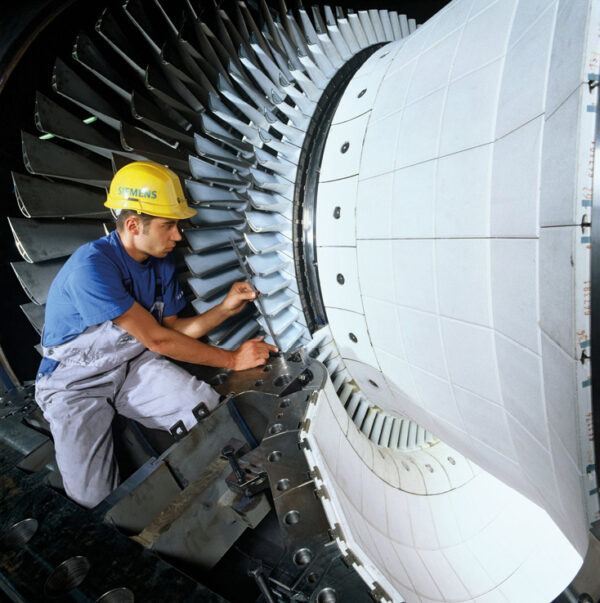
The major turbine manufacturers have taken steps to increase output at existing plants but are cautious about spending big on new production lines. Gas turbine manufacturers took a hit on the stock market in January 2025 when Chinese startup Deepseek AI released a model that claimed to use 40% less energy per task. Share prices bounced back, but it reveals the risk turbine manufacturers are exposed to if the hyperscalers – those tech companies building gigawatt-scale data centers – change their buildout plans.
“In many cases, the existing manufacturing facilities are already operating in a highly optimized way,” said Sam Reynolds, Asia research lead for liquified natural gas and natural gas at IEEFA. “We’ve seen some announcements on behalf of the companies to expand existing facilities or, for example, Siemens announced that it would be running on 24/7 manufacturing shifts as a way of increasing output from existing facilities. But as far as building new capacity, we haven’t seen much movement there. I think companies are hesitant to take the risk.”
Reynolds told pv magazine that most of the order backlog for gas turbines consists of large, heavy-duty gas turbines – the kind that can offer combined cycle capacity ranging from 150 MW to 900 MW. Many of these will be installed at data centers.
“Siemens has 26 GW of firm turbine orders, 28 GW of reservations. That’s 54 GW combined and it says that about 12 GW of those are specifically data centers,” Reynolds said. “GE Vernova is also saying that one third of its order book is resulting from AI.”
Plugging the gap
Servicing hyperscale data center demand is an obvious, if imperfect opportunity for solar and storage. US tech companies increasingly need to bring their own generation to secure grid connections for large-scale data centers. These sites need uninterrupted, dispatchable energy, which makes gas a good fit, if carbon emission targets are removed from the equation. But developers can’t get turbines as quickly as they would like. Batteries offer a means of securing an early connection while waiting for the turbine delivery.
“When data centers want to get online now and quickly want to secure a load interconnect by bringing their own generation, we can accommodate that because we have the solar and storage that is ready to go,” NextEra Energy CEO John W. Ketchum told investors on a company earnings call in 2025. Nobody has built more gas-fired generation in the United States over the last two decades than NextEra Energy, and Ketchum argued the company’s unique advantage comes from its renewables and storage business – meaning it can deploy generation more quickly than the time it takes to secure gas-fired generation, allowing data centers to connect and begin operations more quickly.
Analysts at Morgan Stanley also agree that the AI buildout and turbine shortage could support energy storage deployment. In analysis of the global energy sector from November 2025, the bank said it believes the gas turbines shortage may provide an opportunity for energy storage systems to power data centers in 2026, particularly in markets with grid capacity constraints. The bank also noted the economics for energy storage systems could compete with gas and solar. Morgan Stanley analysis reported gas turbine prices had doubled in the past three years, as solar and storage prices fell. NextEra Energy reported the cost of a new natural gas power plant had tripled from $785/kW in 2022 to $2,400/kW in March 2025.
Pressure on Asia
Those changing costs will not have gone unnoticed in Hanoi, Manila and other Southeast Asian capitals. Reynolds authored a report for IEEFA in October 2025 examining how the turbine shortage – in combination with other challenges in the liquified natural gas (LNG) market – are affecting Vietnam and the Philippines. He found 35.9 GW of gas projects in the early stages of development in the two countries, with 10.7 GW in the Philippines and 25.2 GW in Vietnam unlikely to commission by 2030.
Felix Kosasih, Southeast Asia analyst at BloombergNEF, told pv magazine that he expects the gas turbine shortage to have a greater impact on Vietnam than the Philippines, and noted that negotiations for bankable power purchase agreements (PPA) for LNG-to-power projects are “lengthy and uncertain.”
“A slowdown in the gas power project development could accelerate the deployment of renewable energy, such as solar and battery storage, to meet the country’s rapidly growing electricity demand. Vietnam already plans to add 38.7GW of new solar and storage capacity by 2030,” Kosasih said.
Gas project costs could rise further. In addition to servicing their backlog, turbine manufacturers are taking reservation agreements – akin to a memorandum of understanding – for projects in early development, with a fee for delivery slots.
“These slot reservation agreements go back a ways, but they’re really becoming standard in today’s terms and they’re really significant,” said Reynolds. “Companies are reporting that the cost of these reservation agreements can get up to 20% of the total cost of the order. So, if you’re ordering $500 million of equipment your reservation agreement could be $100 million. That’s going to be unaffordable for a lot of Asian nations,” he said.
This should make solar and storage more attractive, as each year of gas turbine delay makes the case for renewables more compelling, as Reynolds explained.
“From an energy policy planning perspective, for Asian countries, every year of delays for gas turbines or LNG import facilities creates another year of opportunity for renewables and storage to either fall in costs or have policy barriers be ironed out and investment avenues opened up,” he said. The IEEFA analyst researcher added that Asian markets switching from using cheaper domestic gas to more expensive LNG imports has created a “double whammy” for gas plants.
“You used to be able to rely on cheaper, faster gas and more expensive renewables. Now that picture has completely flipped,” he said.
This content is protected by copyright and may not be reused. If you want to cooperate with us and would like to reuse some of our content, please contact: editors@pv-magazine.com.



By submitting this form you agree to pv magazine using your data for the purposes of publishing your comment.
Your personal data will only be disclosed or otherwise transmitted to third parties for the purposes of spam filtering or if this is necessary for technical maintenance of the website. Any other transfer to third parties will not take place unless this is justified on the basis of applicable data protection regulations or if pv magazine is legally obliged to do so.
You may revoke this consent at any time with effect for the future, in which case your personal data will be deleted immediately. Otherwise, your data will be deleted if pv magazine has processed your request or the purpose of data storage is fulfilled.
Further information on data privacy can be found in our Data Protection Policy.