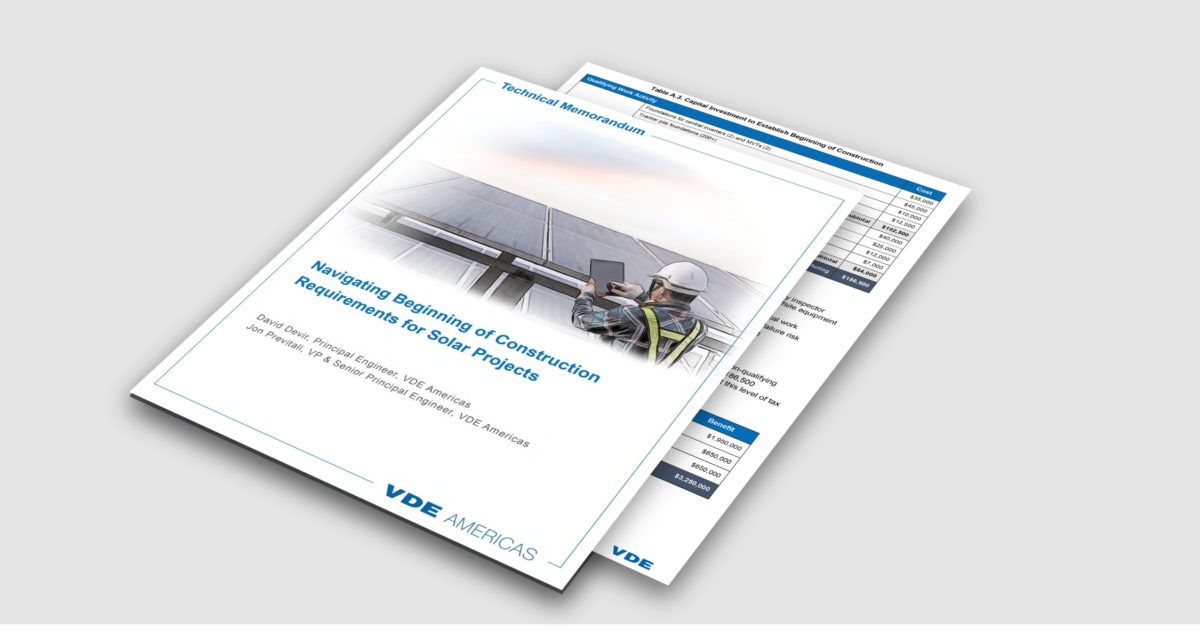





The U.S. solar industry is rapidly approaching a cliff for accessing clean energy tax credits. Following the passage of the One Big Beautiful Bill Act (OBBBA) in July 2025, the grace period for project developers to “safe harbor” their assets under the old rules is nearly over. As the industry pivots from a dollar-based 5% cost test to the more subjective “Physical Work Test,” VDE Americas has released a playbook designed to act as a survival guide for stakeholders navigating the OBBBA’s tightened window.
The OBBBA fundamentally shifted the landscape for project finance by eliminating the long-standing 5% safe harbor allowance for commercial projects. For any solar project over 1.5 MW, developers can no longer simply write a check for equipment to grandfather their tax credits. Instead, they must prove that “physical work of a significant nature” has begun before the fast-approaching July 4, 2026, deadline.
“We’re seeing extraordinary demand for additional power capacity… spurred by energy-intensive industries and the rise of data centers,” said Brian Grenko, CEO and President of VDE Americas. “Solar remains the most cost-effective means for meeting that demand, and VDE is committed to helping clients navigate our dynamic regulatory environment”.
Navigating the “Facts-and-Circumstances” Era
The new playbook, “Navigating Beginning of Construction Requirements for Solar Projects,” addresses the “facts-and-circumstances” nature of the current Treasury requirements. Because there is no longer a bright-line dollar amount to guarantee eligibility, the industry has entered a period of heightened interpretive risk where the focus has shifted to the nature of the work performed.
VDE’s guidance emphasizes that projects missing the July 4 construction commencement date face a “potentially insurmountable” 18-month deadline to be placed in service to retain any tax credit eligibility. To mitigate this, the firm recommends:
- Enhanced Documentation: Developers should adopt rigorous standards, including date-stamped photos with GPS coordinates and detailed inspector reports, to prove that work performed is integral to the facility.
- Strategic Procurement: The memo provides templates for request for proposals (RFPs) that include technical specifications specifically designed to satisfy “physical work” requirements.
- Onsite vs. Offsite Clarity: The guide analyzes which activities—such as the manufacturing of custom transformers or the driving of steel piles—will meet the federal threshold.
The release of this playbook comes as the tax equity market struggles to find a clear pathway in a “post-OBBBA” world. With capital concentrating around projects that can demonstrate execution certainty, technical advisory services like those from VDE are becoming essential for de-risking the supply chain and ensuring project bankability.
“We’re seeing extraordinary demand for additional power capacity throughout the United States, spurred by energy-intensive industries, American manufacturing initiatives, the rise of data centers, and broader electrification efforts,” said Brian Grenko, CEO and President of VDE Americas. “Solar energy remains the fastest and most cost-effective means for meeting that demand, and VDE Americas is committed to helping our clients develop, construct, finance, and operate these power-generating facilities, while navigating our dynamic regulatory environment.”
For developers, the message from the “OBBBA cliff” is clear: the difference between a viable power-generating asset and a stranded one can depend on the ability to satisfy these labor-intensive, specific requirements before the sun sets on the current tax credit regime.
This content is protected by copyright and may not be reused. If you want to cooperate with us and would like to reuse some of our content, please contact: editors@pv-magazine.com.



By submitting this form you agree to pv magazine using your data for the purposes of publishing your comment.
Your personal data will only be disclosed or otherwise transmitted to third parties for the purposes of spam filtering or if this is necessary for technical maintenance of the website. Any other transfer to third parties will not take place unless this is justified on the basis of applicable data protection regulations or if pv magazine is legally obliged to do so.
You may revoke this consent at any time with effect for the future, in which case your personal data will be deleted immediately. Otherwise, your data will be deleted if pv magazine has processed your request or the purpose of data storage is fulfilled.
Further information on data privacy can be found in our Data Protection Policy.