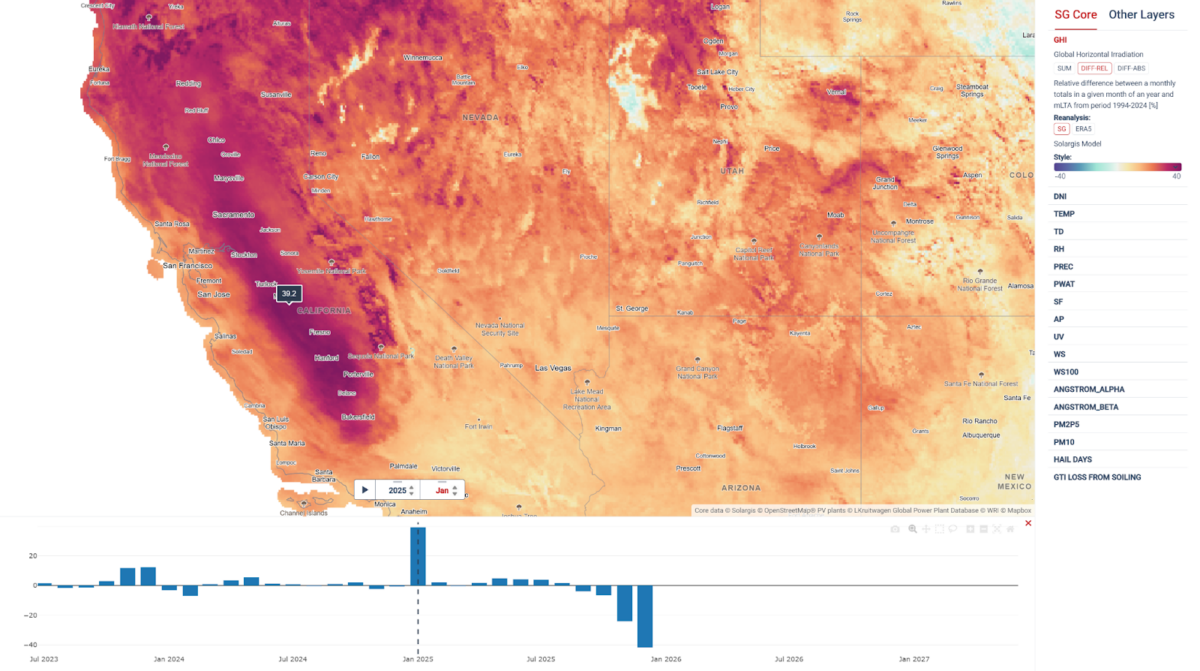





Annual global horizontal irradiance (GHI) maps and single-year irradiance anomalies have increasingly become staples of solar market analysis that inform expectations around project performance. Solar irradiance refers to the amount of radiant light energy from the Sun that reaches the Earth’s surface.
In GHI maps, regions that are shaded above or below average can be interpreted as pointing toward a certain location’s competitiveness or future energy output. But these snapshots might not be strong indicators of what’s next.
“Annual GHI maps are descriptive snapshots,” explained the CTO and co-founder of Solargis, Tomas Cebecauer, meaning that they “cannot be used as predictive tools.”
Instead, Cebecauer told pv magazine USA, the maps simply collate the data and show how solar irradiance behaved over a single year compared to the long-term average. The value of annual GHI maps lies in their contextual awareness, he said, as they remind “stakeholders that variability exists, that different regions behave differently over time and that solar resource risk is inherently dynamic.”
What they weren’t designed for, however, was to be used to draw conclusions about future trends, resource risk or market competitiveness.
“Using one year of aggregated GHI data to infer long-term stability, climate direction or business advantage could be misleading because of the many factors that influence GHI variations,” Cebecauer added. Solar irradiance varies significantly across space and time due to climatic factors like cloud dynamics, atmospheric aerosols and circulation patterns. Short-term weather events don’t necessarily map cleanly onto long-term changes.
In practice, he explained, that means that positive and negative extremes cancel each other out.
“The resulting annual value often masks the very volatility that matters most for operational outcomes,” he added. “A ‘normal’ or slightly positive year does not imply low risk. It simply reflects averaging.”
That effect is especially overt when looking at monthly, not yearly, data. California, for instance, experienced strongly above-average GHI in January and historically low below-average conditions in December. Aggregated annually, those anomalies largely offset each other, resulting in what looked like a near-normal year on the annual map despite significant GHI swings.
Month-to-month variability influences have concrete impacts for developers and financiers. Per Cebecauer, the volatility masked in annual averages can be highly relevant for project performance and financing risk, especially in markets with dynamic pricing and grid conditions.
He also cautioned against recalibrating long-term yield assumptions based on single-year anomalies, as even multi-percent annual deviations can occur without there necessarily being an underlying climate signal.
“Only multi-decade, high-resolution datasets [that are] analyzed probabilistically can begin to separate short-term weather-driven variability from longer-term climate influences,” Cebecauer noted, as year-over-year comparisons simply don’t provide enough evidence of a significant structural change.
“Trying to extrapolate findings to future performance or climate risk or turning these into competitive advantages would risk oversimplifying the results and would be misleading for businesses,” he added.
This content is protected by copyright and may not be reused. If you want to cooperate with us and would like to reuse some of our content, please contact: editors@pv-magazine.com.






By submitting this form you agree to pv magazine using your data for the purposes of publishing your comment.
Your personal data will only be disclosed or otherwise transmitted to third parties for the purposes of spam filtering or if this is necessary for technical maintenance of the website. Any other transfer to third parties will not take place unless this is justified on the basis of applicable data protection regulations or if pv magazine is legally obliged to do so.
You may revoke this consent at any time with effect for the future, in which case your personal data will be deleted immediately. Otherwise, your data will be deleted if pv magazine has processed your request or the purpose of data storage is fulfilled.
Further information on data privacy can be found in our Data Protection Policy.