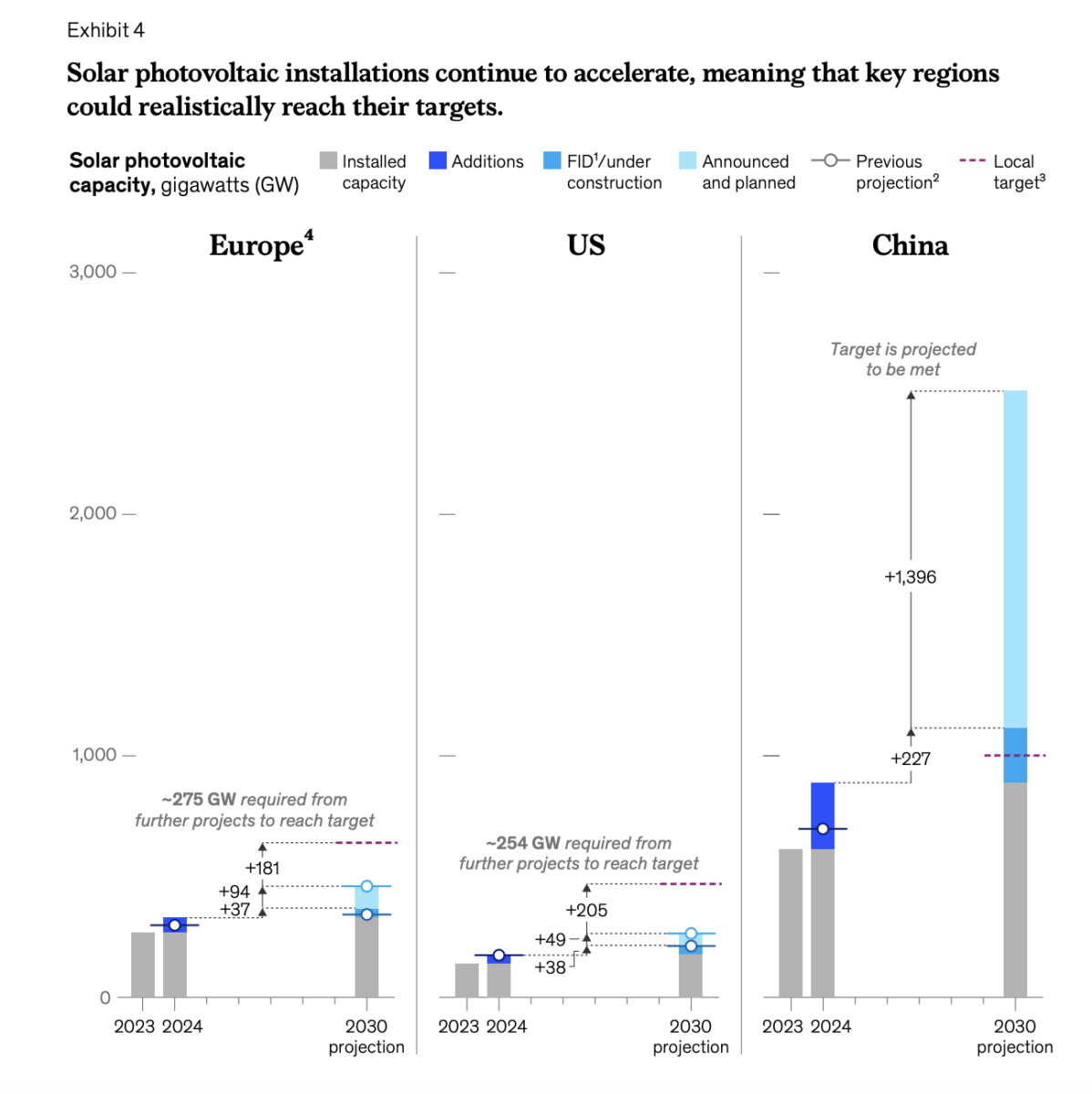





The U.S. and Europe are likely to meet their 2030 solar targets despite current project pipelines being smaller than their end-of-decade targets, according to a report from global management consulting firm McKinsey and Company.
McKinsey’s “Tracking the energy transition: where are we now?” report analyzes the pathway of solar, wind and battery energy storage system (BESS) technologies towards the 2030 deployment targets set by China, the United States and the EU-27, Norway, Switzerland and the UK in Europe.
It says the U.S. is currently around 254 GW away from its 2030 target while Europe is around 275 GW away. In contrast, China has already more than doubled its 2030 target.
Despite the U.S. and Europe currently lacking enough announced capacity to meet their 2030s targets, by around 205 GW and 181 GW respectively, McKinsey’s analysis says they are still likely to find this additional capacity and reach their end-of-decade thresholds thanks to the ease of building out solar.
“While it is easier to track project build-out for other clean energy technologies, data visibility for solar is more limited due to individual household use and ease of build-out,” McKinsey’s report explains. “For example, a consumer can install household solar in two months. This means that the announced capacity may be underestimated in this analysis.”
Diego Hernandez Diaz, a partner at McKinsey, told pv magazine that while core markets will continue their build out, further demand growth will also occur in less saturated core markets such as Poland. “The advantage of some of these elements is that the more nascent markets can have a better economic trade off and can be built in an economically pragmatic way,” he explained.
The report does acknowledge that this growth trajectory is not guaranteed, citing supply chain risks, tariffs, shifting policy focus and growing political uncertainty as factors that can slow down progress. Hernandez Diaz added there will likely be an effect from shifting regulation across the board.
“Perhaps more importantly, however, is that beyond any regulation, what we continue to see is that if the underlying economics work, then deployment accelerates,” he stated. “All major geographies covered in the report have the underlying fundamentals to support accretive deployment of further renewable energy sources.”
The report also notes that the battery energy storage system (BESS) pipeline is growing rapidly across China, the U.S. and Europe, but remains behind what is needed to meet 2030 targets. McKinsey estimates around an additional 123 GW is required in China, 154 GW in the U.S. and 221 GW in Europe.
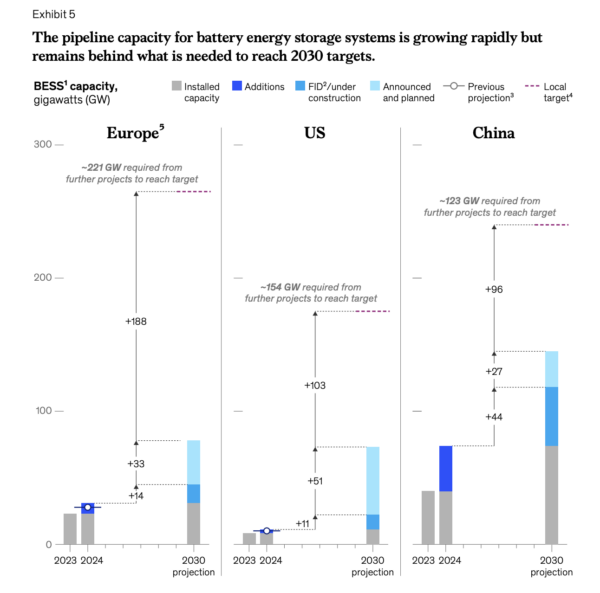
The analysts says BESS remains the dominant question mark but can be sited, permitted, constructed, and interconnected far faster than technologies such as nuclear or gas with carbon, capture, utilization and storage (CCUS) contributing to its rapid growth in recent years.
The report attributes the rapid acceleration of BESS installation to a positive business case for both large-scale operators and households when paired with solar. “Load balancing is also becoming a popular source of revenue for battery operators,” the report adds. “Planning and integrating BESS with renewable rollout is critical if 2030 net-zero targets are to be met.”
This content is protected by copyright and may not be reused. If you want to cooperate with us and would like to reuse some of our content, please contact: editors@pv-magazine.com.




By submitting this form you agree to pv magazine using your data for the purposes of publishing your comment.
Your personal data will only be disclosed or otherwise transmitted to third parties for the purposes of spam filtering or if this is necessary for technical maintenance of the website. Any other transfer to third parties will not take place unless this is justified on the basis of applicable data protection regulations or if pv magazine is legally obliged to do so.
You may revoke this consent at any time with effect for the future, in which case your personal data will be deleted immediately. Otherwise, your data will be deleted if pv magazine has processed your request or the purpose of data storage is fulfilled.
Further information on data privacy can be found in our Data Protection Policy.