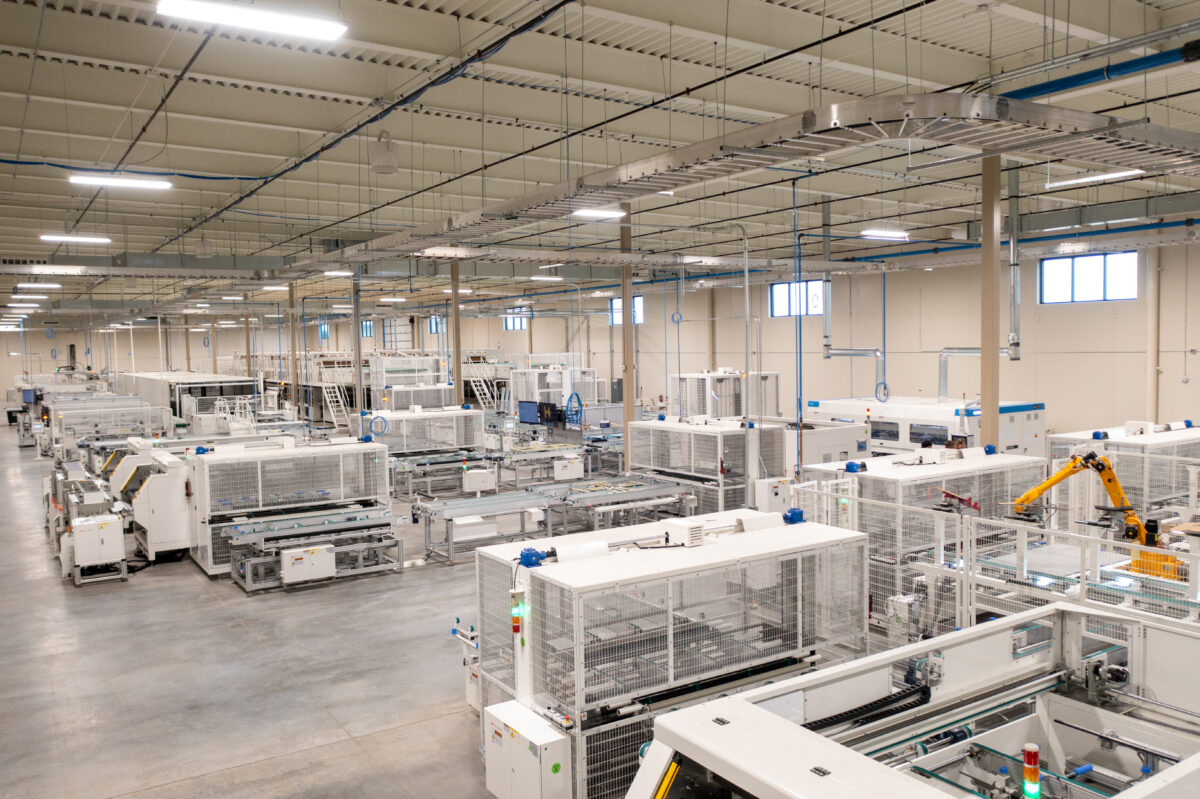





Whatever one thinks of the term “vibe shift,” there is definitely something in the air of the PV industry. Developers are rushing to meet federal tax deadlines. Engineering, procurement and construction companies are scrambling to secure U.S.-sourced components. Manufacturers are building production facilities inside the tariff wall.
Heliene Inc., a Canada-based developer of PV modules with manufacturing facilities in Minnesota, exemplifies the current vibe with the term “FEOC free” prominent on its website, with the acronym standing for “foreign entity of concern,” (i.e., China). Leading with this, an American flag and a promise to fulfill a customer’s domestic content requirements suggests a lot about what is topical in North America’s solar industry.
If compliance issues are front and center, the company wants to point out that there is still a lot of room for performance and cost improvements in PV architecture. Heliene CEO Martin Pochtaruk sat down with pv magazine USA to discuss why PV manufacturers need to be research and development companies as well, and how rules and requirements can still tarnish solar’s bright future.
pv magazine: Heliene opened its second U.S. manufacturing facility in Minnesota last year. What brought you south?
Martin Pochtaruk: We started out as a business to manufacture modules for power generation back in 2010. We have focused on the U.S. market over time because the Canadian market is very small by comparison, in part because the price of electricity is so low. In Ontario, where we’re headquartered, we had replaced 100% of coal with wind and solar by 2013. But our population is small and demand growth is almost non-existent compared with the U.S.
pv magazine: What are the advantages of remaining a Canadian company if so much of your business focus is in the United States?
Martin Pochtaruk: That is an important question about our company, how does a small business in the middle of nowhere manage to be successful and to grow? The answer is that have always invested in research and development (R&D) and that aspect of being a technology company benefits from our Canadian roots. The main reason we have done a lot is because the Canadian government for over 30 years now has had an investment tax credit program that gives you 35 cents on the dollar from everything you do in R&D.
pv magazine: So, you can do your research in Canada while still operating in the U.S. market.
Martin Pochtaruk: We manufacture in the U.S. for the domestic market and employ 550 people in Minnesota, right? At the same time, our R&D is done north of the border. This has allowed us to be competitive in a number of areas. For example, we worked with SpaceX to develop and manufacture the solar modules for the Starlink satellites, which we have been providing for three years.
pv magazine: In addition to developing modules for space, you supply modules for a variety of rooftop and ground-mount commercial and utility projects. You also offer PERC and N-type module lines with different power outputs. Do you find it difficult as a small company to maintain product lines with different technologies?
Martin Pochtaruk: We also had an HJT module line that we took over in Florida in 2020. HJT cells are manufactured either in China or Russia. When we were not allowed to import from China we imported from Russia. That ended in 2022 with the Russian invasion of Ukraine, although we had a grandfathered contract. When that came to an end there was no place in the world to get heterojunction cells. They were valued in the residential market because they were very black and blended with roofs.
But to your question about the reason for PERC and N-type: The reason we do PERC is because the only cell manufacturer in the U.S. is Suniva, and that’s what they make. The cells are there and we are going to use them because certain customers want them or need them for domestic content requirements. If clients want domestic cells, that’s Suniva. And that’s PERC. They have the advantage of being the only game in town. Little by little, starting this year, you will see other manufacturers coming online, and then there will be other domestic cells of different types on the market.
pv magazine: One of the things you are bringing home is how regulation-driven, and even politics-driven, the solar industry is. Dumping by China, Russian invasions, changes in U.S. administrations: All of these are affecting technology direction and product choices, even in a so-called free market. What are you looking to provide with your advancing technology that will keep your customers supplied and in the good graces of the various regulatory environments that are cropping up everywhere.
Martin Pochtaruk: I can respond to that question with one word: alternatives. Our R&D enables us to keep the products our customers choose viable for the long term. Our manufacturing gives them workable and economic choices to begin with.
Domestic content is percentages. We can offer a client a module that we build outside the U.S., so zero domestic content. On the other side, we have the same module that has, when you look at the safe hardware list of domestic content, everything made in the U.S. except the glass. Solar glass is not made in the U.S. for the time being, so we import that. For everything else we have been able to develop a solar supply chain in the U.S. That includes the Corning polysilicon ingots and wafers and Suniva cells.
Our clients pick and choose their components from a drop-down menu. That’s where you say, “this component I want domestic, this I don’t want domestic.” Domestic content changes cost, which changes what projects might be economically feasible. And we can make that menu fit what the client is looking for. That’s why we have the choices in our product lines.
pv magazine: You were just talking about product viability over the long term. One issue we have been looking at recently is midlife repowering of solar projects. You know, like an array with a lifespan of 25 or 30 years is nearing the 15-year mark. Maybe it’s cost-effective to replace certain components. As a module manufacturer, what’s your take on repowering?
Martin Pochtaruk: One of the biggest challenges with repowering is finding modules that fit into the racking that you had in place. We went through a repowering issue in Ontario not too long ago. A lot of rooftop solar installed in 2013 to 2015 is at middle age, and this was from the feed-in-tariffs era that was extremely rich, so you’d want to refurbish those.
But the problem is that the modules with that original width and height don’t exist anymore, so you have to replace the racking and mounting. That’s not generally possible with a rooftop system. The industry went from M2 [156.75mm wafers] or M2 plus to M10 [182mm] in a relatively short period of time. In between were M6, which lasted for about a year. The issue is that the industry evolved into a larger footprint and is still evolving.
pv magazine: Let’s say let’s say you’re looking at more of a utility scale situation. You are producing below your early capacity, why not boost it up and increase your revenue?
Martin Pochtaruk: So, that’s a slightly different question. But again, changing technology can undermine some those repowering situations. But you might need to change a lot of the cabling and inverters. We’re generally working today with modules at 1,500V as opposed to the 600V that was the maximum back in 2010, right? So, it’s not just slapping a new module on there.
pv magazine: In addition to manufacturing capabilities, you have emphasized Heliene’s legacy as a solar R&D company. Looking ahead, do you think advancing technology will continue to keep solar attractive?
Martin Pochtaruk: The future is a challenge because costs continue to go up. And that’s nothing about what we’re doing. When you look at aluminum and steel prices in the U.S., they are 50% to 75% higher than they were a year ago. That affects all infrastructure, from bridges to solar installations. The racking costs more. All the structural steel costs more. Our modules have aluminum frames or steel frames, and those cost more.
So, the race right now is how to keep those projects financeable so that they can be built. Many projects start to not pencil economically because of cost creep. One way to address this is to enable developers and owners to renegotiate their power purchase agreements. But some are not able to do that. For example, NYSERDA [the New York State Energy Research and Development Authority] doesn’t allow you to renegotiate costs. That means some projects will not go ahead because of inflationary pressure.
On top of that are pressures imposed by import duties and anti-dumping cases. There are cases right now against India, Laos and Indonesia. And there are not too many countries left where we can import cells from. Turkey and the Philippines, maybe? Because there’s not enough manufacturing in the U.S., those costs continue to go up. There not much R&D can do about that when it’s a decision of the U.S. Department of Commerce.
This content is protected by copyright and may not be reused. If you want to cooperate with us and would like to reuse some of our content, please contact: editors@pv-magazine.com.



By submitting this form you agree to pv magazine using your data for the purposes of publishing your comment.
Your personal data will only be disclosed or otherwise transmitted to third parties for the purposes of spam filtering or if this is necessary for technical maintenance of the website. Any other transfer to third parties will not take place unless this is justified on the basis of applicable data protection regulations or if pv magazine is legally obliged to do so.
You may revoke this consent at any time with effect for the future, in which case your personal data will be deleted immediately. Otherwise, your data will be deleted if pv magazine has processed your request or the purpose of data storage is fulfilled.
Further information on data privacy can be found in our Data Protection Policy.