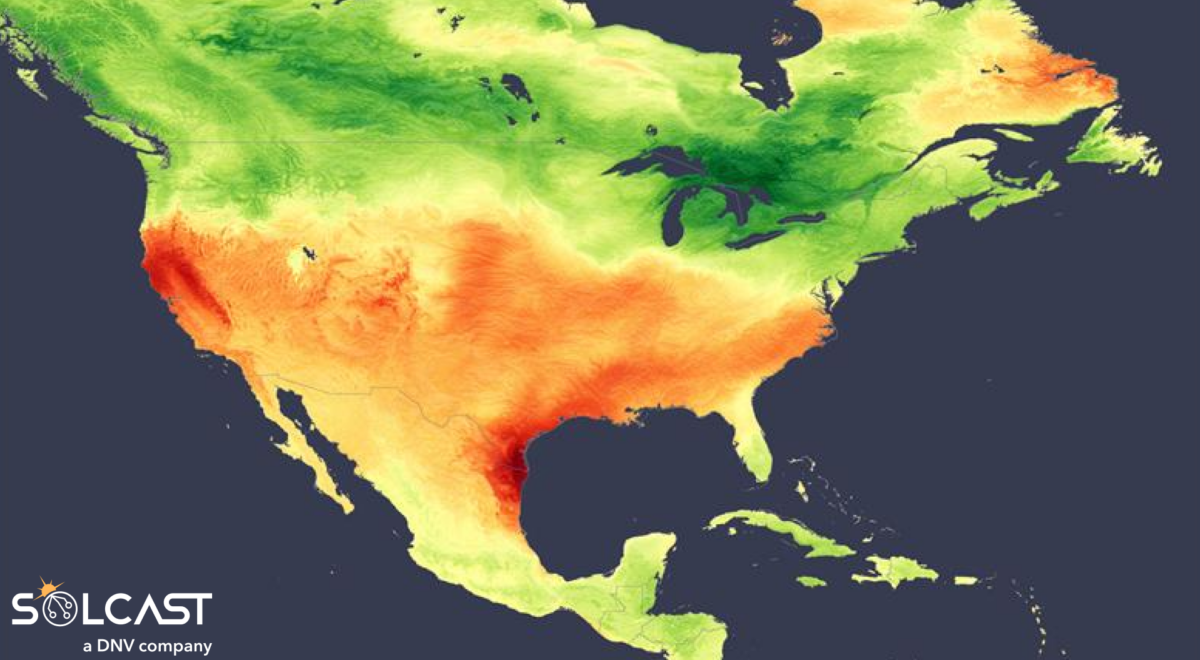





North America experienced a pronounced divide in solar conditions through March, with the southern half of the continent recording widespread increases in solar resource while the north faced persistent cloud and storm activity, according to analysis using the Solcast API.
The strongest gains were centered on northeastern Mexico and southeastern Texas where deviations reached roughly 20–25% above the long-term March average, with much of California also seeing similar increases. Canada, the Great Lakes and the northeastern United States recorded lower-than-normal irradiance as polar air and storm systems dominated conditions. This produced a month in which the usual seasonal contrast between north and south was sharpened, with clearer skies in the south and cloudier conditions in the north compared with the 2007–2025 average.
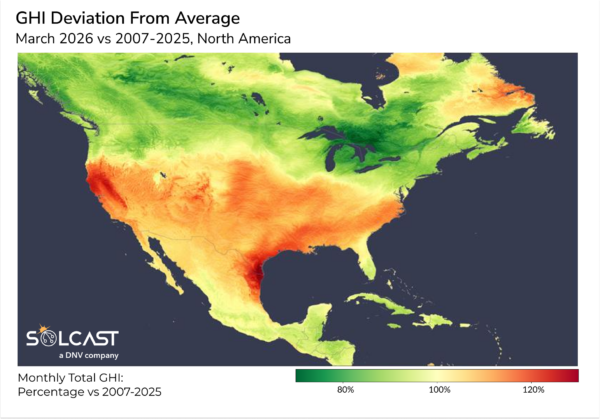
Much of the southern United States and northern Mexico benefited from a pair of high-pressure systems positioned over the Pacific and Atlantic coasts of North America. These systems stabilised the atmosphere and kept skies clearer than normal across large areas. Southern Mexico and Florida were exceptions to the southern trend, each experiencing slightly below average irradiance where localised cloud cover persisted.
A pronounced heat dome over the southwestern United States further reinforced these conditions, driving temperatures 10–19 C (18-35 F) above seasonal norms and breaking multiple records, as localized areas saw even large increases. These warm conditions, more like summer temperatures than spring, were the result of high atmospheric stability, which also suppressed cloud formation and supported extended periods of clear skies. As a result, California emerged as one of the strongest-performing regions relative to average conditions, with irradiance levels significantly elevated through much of the month. The scale of the heat anomalies was notable, with attribution studies indicating these extremes would be highly unlikely without the influence of climate change.
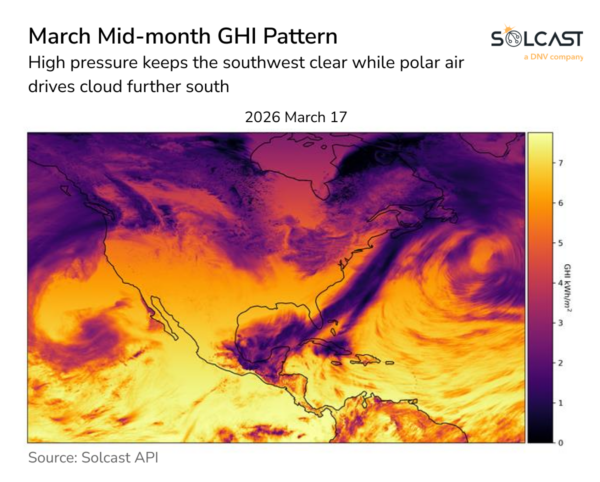
At the same time, northern parts of the continent experienced a very different pattern as an unstable polar vortex pushed cold polar air into Canada and the northern United States. This brought snowstorms and blizzards across several regions, particularly around the Great Lakes and the Northeast, where irradiance fell far below normal for March. These stormy conditions contributed to the largest percentage drops from average in areas north of the Great Lakes.
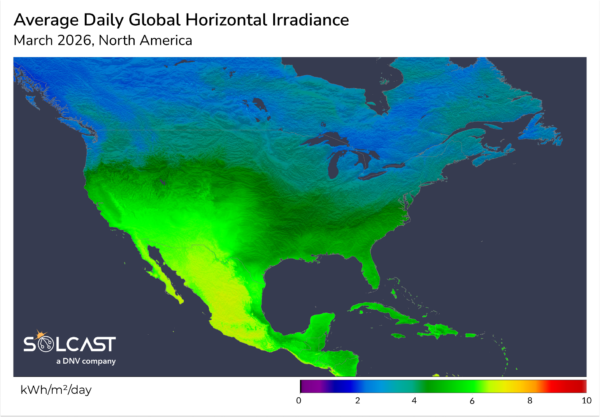
The push of polar air extended unusually far south, reaching into Florida and contributing to its slightly below normal irradiance despite the generally sunnier conditions across most of the southern half of North America. Collectively, these factors reinforced the strong contrast between the sunnier southern regions and the cloudier, storm affected conditions across the north.
Solcast produces these figures by tracking clouds and aerosols at 1-2km resolution globally, using satellite data and proprietary AI/ML algorithms. This data is used to drive irradiance models, enabling Solcast to calculate irradiance at high resolution, with typical bias of less than 2%, and also cloud-tracking forecasts. This data is used by more than 350 companies managing over 300 GW of solar assets globally.
The views and opinions expressed in this article are the author’s own, and do not necessarily reflect those held by pv magazine.
This content is protected by copyright and may not be reused. If you want to cooperate with us and would like to reuse some of our content, please contact: editors@pv-magazine.com.




By submitting this form you agree to pv magazine using your data for the purposes of publishing your comment.
Your personal data will only be disclosed or otherwise transmitted to third parties for the purposes of spam filtering or if this is necessary for technical maintenance of the website. Any other transfer to third parties will not take place unless this is justified on the basis of applicable data protection regulations or if pv magazine is legally obliged to do so.
You may revoke this consent at any time with effect for the future, in which case your personal data will be deleted immediately. Otherwise, your data will be deleted if pv magazine has processed your request or the purpose of data storage is fulfilled.
Further information on data privacy can be found in our Data Protection Policy.