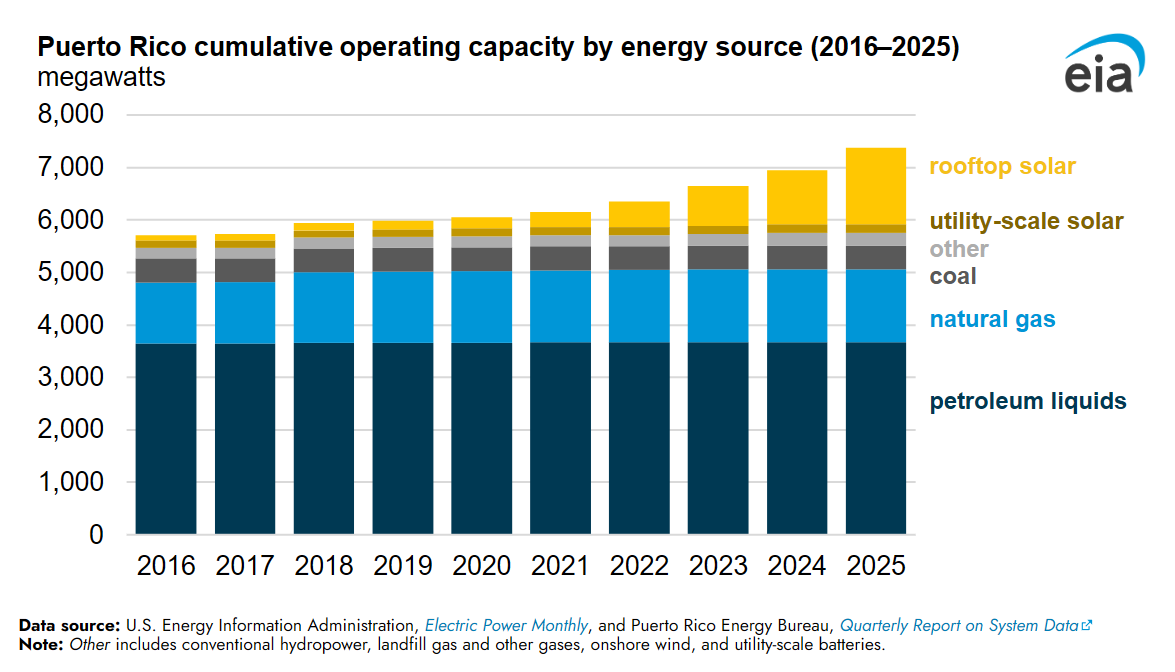





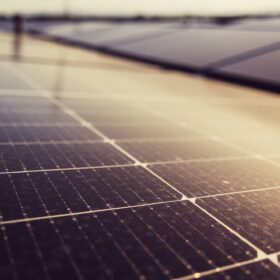
Recently-released data from the U.S. Energy Information Administration (EIA) indicates that 20% of all power generation capacity in Puerto Rico now comes from rooftop solar, surpassing natural gas to become the second-largest capacity source in the territory.
The growth rate in rooftop solar capacity has outpaced all other energy sources in Puerto Rico over the last decade. According to EIA data, distributed solar installations represented 81% of all new generating capacity added to the island’s grid between 2016 and 2025.
During 2025 alone, an average of 3,850 rooftop systems were installed at homes and businesses each month, bringing the total number of active systems in the territory to 191,929 by the end of the year.
Rooftop solar capacity growth has been a bright spot in Puerto Rico’s energy story. The 1,456 MW of capacity it represents dwarfs the estimated 165 MW of utility-scale solar installations in the territory.
PJ Wilson, president of the Solar Energy and Storage Association Puerto Rico industry group, says his organization is committed to continuing to grow distributed solar across the territory.
“We are committed to building on this momentum and ensuring rooftop solar and storage continue to grow as a key part of Puerto Rico’s energy system to strengthen the grid and expand energy independence,” he said in comments to pv magazine USA.
Notably, solar generation capacity on the island has not resulted in a reduction in capacity from other sources, with very little change in the capacity represented by petroleum, natural gas and coal over the previous five years.
In 2025, Puerto Rico governor Jenniffer González Colón signed Act 1-2025 into law, which extended the lifespan of the territory’s only coal-fired power plant through 2032, despite major pushback from the island’s citizens.
The controversial law also significantly altered the territory’s renewable portfolio standard goals, eliminating interim targets for 40% renewables by 2025 and 60% by 2040 while retaining the overall goal of 100% renewable energy by 2050.
Battery storage and virtual power plants
Resilience and stability of the Puerto Rico grid have become especially important in recent years. Data shows that the average utility customer on the island experienced a minimum of 27 hours of electricity interruptions per year, with a maximum of nearly 200 hours of outages, depending on major weather events.
In response to these events, residents have adopted distributed energy storage at rates far higher than on the mainland. The Puerto Rico Energy Bureau estimates there were more than 171,000 households and businesses in Puerto Rico with a distributed battery system at the end of 2025, representing a total energy capacity of 2,864 MWh.
Industry analysts at Wood Mackenzie predict an additional 3,000 MWh of this kind of distributed energy storage by 2030.
Many of the island’s battery storage owners contribute to the stability of the grid through participation in virtual power plants (VPPs) under the Customer Battery Energy Sharing (CBES) program offered by territory grid operator LUMA.
Through the program, LUMA works with energy storage aggregators that maintain and control fleets of customer-sited batteries all across the territory. The utility calls upon these aggregators to take control of customer batteries during “CBES events” — short time periods during days when the grid’s power needs are projected to exceed available generation supply.
LUMA currently lists seven such aggregators on its website, through which homeowners can sign up to receive payments for allowing their batteries to be controlled by aggregators.
The failures of the Puerto Rican grid have also caused a shakeup at LUMA. New CEO Janisse Quiñones began her tenure on March 30, 2026, promising to bring her experience as CEO and Chief Engineer of LADWP to bear as she focuses on improving the reliability of Puerto Rico’s grid.
Wilson says his organization is optimistic that LUMA’s new CEO will help deepen collaboration with clean energy advocates. “SESA remains focused on advancing policies that allow rooftop solar and battery storage to keep growing as a central pillar of Puerto Rico’s energy future, and we’re encouraged by the opportunity for stronger collaboration under LUMA’s new leadership,” he said.
This content is protected by copyright and may not be reused. If you want to cooperate with us and would like to reuse some of our content, please contact: editors@pv-magazine.com.




By submitting this form you agree to pv magazine using your data for the purposes of publishing your comment.
Your personal data will only be disclosed or otherwise transmitted to third parties for the purposes of spam filtering or if this is necessary for technical maintenance of the website. Any other transfer to third parties will not take place unless this is justified on the basis of applicable data protection regulations or if pv magazine is legally obliged to do so.
You may revoke this consent at any time with effect for the future, in which case your personal data will be deleted immediately. Otherwise, your data will be deleted if pv magazine has processed your request or the purpose of data storage is fulfilled.
Further information on data privacy can be found in our Data Protection Policy.