




The sudden emergence of plug-in solar is timely, given the high concern about energy affordability. It offers renters and apartment dwellers – over a third of U.S. households – a way to cut their utility bills with solar power, complementing rooftop and community solar.
Given the buzz around it, I was asked by one of my clients, the Clean Energy States Alliance (CESA) to develop a short report for state energy agencies. With 28 or so state legislatures considering plug-in bills, state energy staff are busy coming up to speed.
While my CESA paper mostly discussed the theory of plug-in solar, including regulatory and programmatic issues, I thought I should do some field research on the practice – by installing my own system.
Plug-in theory
The defining characteristic of plug-in solar (also called balcony or DIY or plug-and-play solar) is that it can be installed by an amateur and plugged into an existing outlet, without the involvement of an electrician.
It falls in the spectrum between solar for recreational vehicles and standard residential rooftop systems. Installations typically range from one to four panels, or 400 to 1200 watts. They are mounted on balconies, backyards, sheds, and elsewhere. In fact, people are coming up with many innovative ideas, like this PV table from GoSun.
In most places, plug-in solar is neither legal nor clearly illegal, since laws and regulations do not address it. City permits don’t typically cover plug-in appliances that are not permanently installed. Utility interconnection agreements govern systems that export power onto the grid, which a small solar system may or may not do. But many companies, customers, and others will hesitate to get involved until the rules are clarified.
The biggest regulatory concern – energizing lines during an outage and putting line workers at risk – is not really an issue, since inverters are covered by UL 1741, and have “anti-islanding” capability.
Plug-in practice
Despite my master’s in energy analysis and policy (go Badgers!) and 30 years in energy advocacy, grantmaking, and research, I never really had to understand amps and volts, or the difference between serial and parallel wiring. With DIY solar, those are fundamental. Most people won’t want to figure all that out, so will want a pre-fab kit with compatible equipment and ease of assembly. But you pay for that convenience.
I wanted to see where the US market is headed, not just where it is now in its infancy. Europe is the model, with possibly 4 million systems in Germany alone. While there are many vendors in Europe, Ikea’s plug-in solar partner, Svea Solar, has kits starting around EU450, for two 500W panels, an 800W-AC inverter, cables and mounts. There is no VAT charged, and Ikea members get a 15% discount.
This works out to only $0.65 per watt of AC output, reflecting a mature and active market, with many retailers, distributors, and equipment manufacturers.
Here in the U.S., an equivalent kit from Brightsaver is approximately $1.60 per AC watt, plus tax, picked up at their Bay Area or Los Angeles locations. EcoFlow offers a kit for $1.58 per AC watt plus shipping, but only in Utah so far.
In the name of research, and because I’m a cheapskate, I set out to achieve the German Ikea price.
But as experienced DIY people know, it’s best to practice on someone else’s project. My friend Marco loved the idea of adding plug-in solar to supplement his existing rooftop system, so he bought the Brightsaver “NEM expansion kit.” (Brightsaver spotted that current California solar customers can add up to 1 kW to their existing system with no further permission needed and without losing NEM status (see page 27 of CPUC Decision 14-03-041.)
I discovered two key things – first, getting two large panels up to a second story roof is tricky. Fortunately Marco is a sailor and tied some excellent knots so we could lift the panels with rope.
Second, panels with a proper tilt angle can absorb a lot of wind force – they are like sails. We did a ballasted system on his flat roof to avoid penetrations, with cement blocks. But a windy night nearly pushed everything over the edge. We added some sandbags and roped them to anchors on the roof soffits.
Hitting the Ikea price meant I couldn’t just get the Brightsaver kit. Here in the SF Bay Area there are plenty of used solar panels on Facebook Marketplace and Craigslist. Indeed, the homeless camps get used solar panels from Urban Ore, our local building materials recovery store. I got four 315 W panels from some dude in Richmond for $50 each, or 16¢ per watt. I tested the voltage, which looked pretty good.
Getting the inverter was harder, since I could find only three models with 120 volt output, and just two of them are UL-certified. Rooftop systems use 240v, as do European plug-in inverters. I got the AP Systems EZ1-LV 960 watt-AC inverter from Miga Robotics in Oregon for $350. I’m sure the price will come down as more companies make similar products.
I’m running 1.2 kW DC through the inverter, for an inverter loading ratio (ILR) of 1.25, which is slightly above the national average of 1.16 for distributed solar, according to Berkeley Lab’s Tracking the Sun.
It took me a few YouTube videos to understand parallel and series wiring, to plug four panels into the two circuits of the inverter. A set of long Y-cables from Amazon was $60.
Next was installation. I have a nice flat garage roof with almost no shading. An added plus is that the outlet in the garage is at the end of the circuit, which I learned from a paper by Berkeley Lab’s Daniel Gerber et al., is the right place to plug in to avoid “breaker masking.” While that paper is not exactly a how-to manual, it does cover the main safety issues: touch safety, circuit overload, and ground faults.
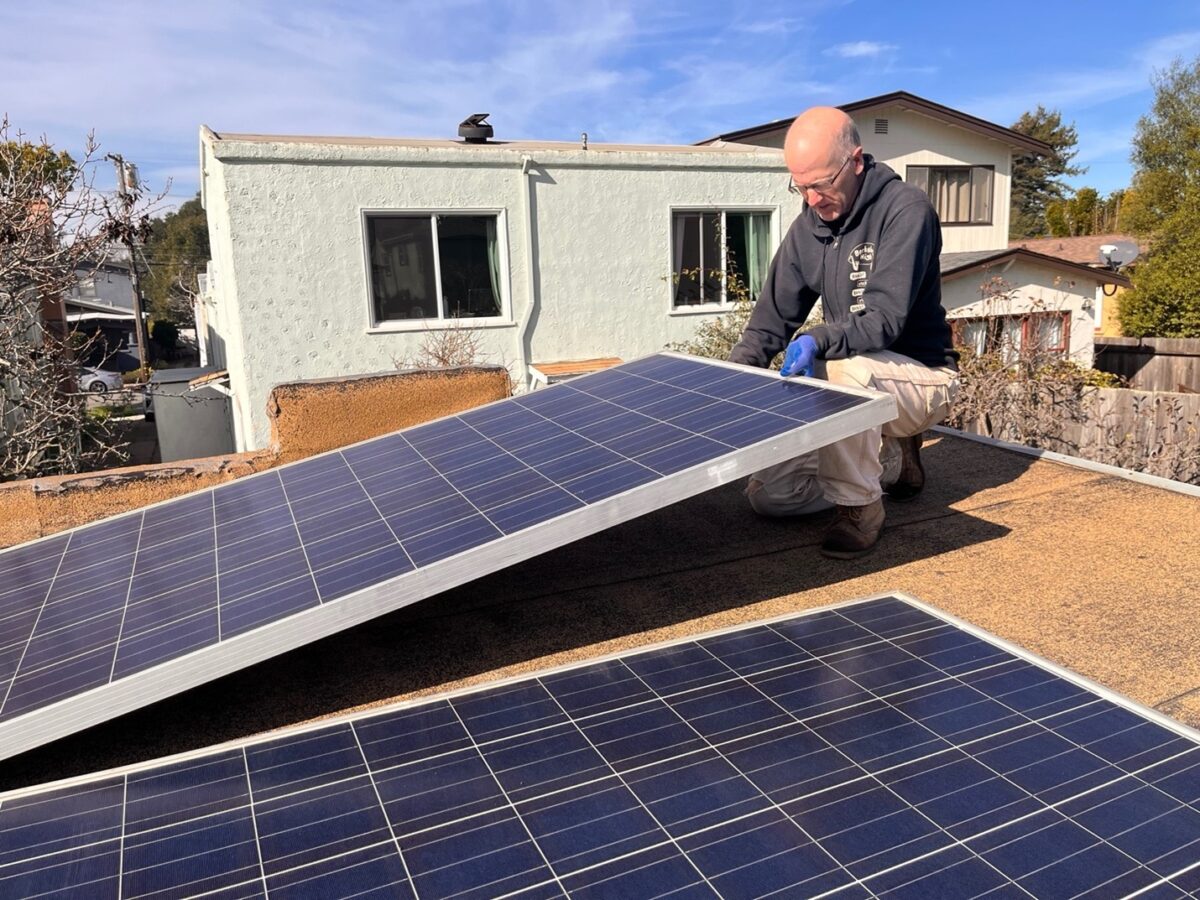
I got four concrete footings from Home Depot for $25, then put a couple of steel pipes that I already had across them. I zip-tied the panels to the pipes, though because they are only about a foot off the deck on one side, I don’t think they are going anywhere. The panels all face south but have a low tilt angle, which means they will get their best output in the summer, but poor output in the winter, when it’s more likely to be cloudy anyway.
I put the inverter in the garage, ran the Y-cables through a hole I drilled in the wall, and plugged the inverter into the outlet. Done.
Unlike my vintage 2011 rooftop system with an SMA string inverter, my new system is wifi-connected, so I can see I’m producing around 5.5 kWh per day now in March, with daily peak output around 850 watts. At a retail rate of 30¢ per kWh, that’s about $50 per month in savings. Given a total cost of $635 – 66¢ a watt, bullseye! –– my payback should be just over a year. Of course, for systems that cost more or are in locations with less sun or lower electricity prices, the payback period will be longer.
Building the market
Making this a reality for all will take a number of steps.
Most of the legislative and regulatory attention is appropriately focused on safety. (The CESA paper includes an overview of the safety issues.) UL Solutions has put out UL3700 (which can be viewed online), and now offers testing and certification. Since it is not an official UL standard, they can take comment and consider changes at any time. If you have substantive comments, drop them a line.
Local permitting agencies can choose to get involved, though they don’t normally cover plug-in appliances. Federal laws in Germany limit local regulations, but do encourage customers to register their systems. About one in four systems is registered.
Grid relations are the next issue to resolve. Utah (and soon Virginia) “legalized” plug-in solar largely by exempting small systems from net metering. This eliminates the paperwork, but does mean that any power generated in excess of demand in real time, and exported to the grid, is not compensated at all. It is given to the utility, which tends to erode the profitability of the investment! Whether a system will export depends on the customer’s load, and whether a battery and controller will head off the exports. Adding to an existing system that already has an interconnection agreement may avoid this issue, making NEM expansion kits an early opportunity.
Manufacturers and packagers are stepping up. A new example is a kit from Pii Energy that combines solar and a battery with smart outlets and a system controller, specifically addressing UL rules and avoiding exports to the grid for customers without interconnection agreements. Small batteries with on-board inverters may displace stand-alone inverters, while enabling non-export and a little bit of insurance against outages.
Logistics and distribution have to be worked out. I got used panels not only because they were cheaper but because they were available locally. Shipping just a couple large rigid panels is quite expensive, so distributors will need solutions other than FedEx. An obvious retailer is a local rooftop installer, who buys panels and inverters by the pallet and can sell them from their warehouses. They’ll have to fight with Amazon and their network of warehouses. Eventually big box retailers may get involved, like Home Depot, Lowe’s and Walmart. Other vendors are trying flexible or folding panels that are easier to ship.
Lastly, since the vision is for amateurs to DIY the installations, they will need some instruction. YouTube university is the place where people go for how-to videos, so solar marketers, local governments, utilities, and advocates can all offer content, plus in-person events and other outreach.
None of these issues seem hard to resolve, and innovation will come quickly once the regulatory door is opened. Having done my own, I can see how theory needs to evolve into practice before millions of DIY systems appear across the country.
Bentham Paulos is a consultant in Berkeley, working with the Clean Energy States Alliance, Berkeley Lab, and California CCAs. See more at PaulosAnalysis.com.
The views and opinions expressed in this article are the author’s own, and do not necessarily reflect those held by pv magazine.
This content is protected by copyright and may not be reused. If you want to cooperate with us and would like to reuse some of our content, please contact: editors@pv-magazine.com.





Enjoyed Mr. Paulos’ article, interesting, and encouraging. Very helpful, like Mr. Faruqui’s writing and experiment demonstrations.
THIS IS A GREAT ARTICLE!!! I also have a 2011 system (and also in the Bay Area), and so our NEM 1.0 deals end in 2031. BUT — I won’t do this just to sell a little more power to PG&E. I want the extra 1kW of power to be battery-banked and drawn first for my expensive evening time of use hours. Have you dug deeper as to how that can happen — can the inverter go into a battery bank that goes into the wall and the battery bank can then either “activate” during evening hours, or more sophisticatedly, the battery senses the amount of evening draw from the house and then meters out its energy to meet the evening draw?