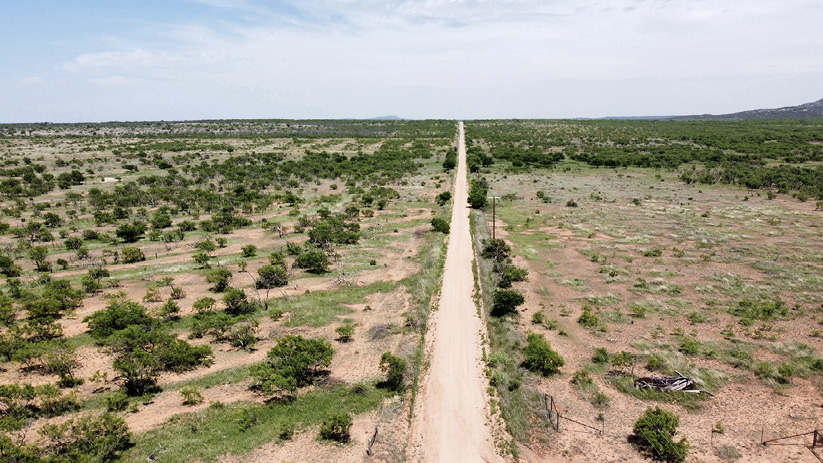





Utility-scale solar projects are larger, interconnections are slower, and engineering decisions must anticipate regulation and supply chains years in advance. At the CT Solar Platform in Snyder, Texas – a 1.6 GW AC single-site development – the first phase, CT Solar One (110 MW AC), has been a test bed for integrating civil design, BOS optimization and domestic-content strategy. Levona Renewables led the development and engineering of the project and CEO Fernando Queiroz shares some key lessons.
On utility-scale sites like this one in Snyder, Texas, micro-terrain matters more than contour lines. The CT Solar Platform had long gentle slopes that seemed straightforward for tracker installation. Once we began geotechnical and civil modeling, it became clear that natural drainage swales, soil transitions, and micro-basins would require the design to evolve.
The main lesson was that trackers could not function as the site’s drainage plan. On small projects, engineers sometimes use tracker rows as hydrological boundaries – simple lines that guide where rainwater flows and separate one watershed from another. This works at small scale because the land is relatively uniform and requires minimal earthmoving. On a large site, the grading volumes needed to level or reshape the terrain can reach hundreds of thousands of cubic meters. When earthworks become this large, the landform itself dominates water behavior, and tracker rows are no longer meaningful boundaries. The drainage system must be engineered first, and the tracker layout shaped around it.
At CT Solar One, we started by modeling how water would move across long corridors of the site under different storm events, using corridor-level statistical modeling – essentially a way to predict flood paths, erosion risks and high-flow zones over distances of hundreds of meters. The trackers were then aligned around defined drainage corridors. This reduced cut-and-fill needs; less soil had to be excavated (“cut”) or placed (“fill”) to achieve stable grades and avoid future erosion along access roads and array blocks.
Laying foundations
Large single-site platforms amplify every assumption error. Rock refusal, for example, occurs when pile foundations cannot penetrate the ground because of a rock layer. On small sites, this can be treated as an isolated contingency. On a site the size of Snyder, refusal pockets can emerge suddenly within a few hundred meters. Refusal must be treated statistically at corridor scale, rather than row by row. Engineers model the likelihood of refusal across long stretches of the site to plan foundation types, pile lengths and construction sequencing.
The most effective technique was what we call inverse geotechnical modeling. Instead of designing foundations and reacting to refusal during construction, we identified refusal-prone zones early, ran parallel structural alternatives, and redesigned blocks around those constraints. This allowed us to predefine mitigation measures such as shorter piles, micro-shifts in tracker corridors, limited pre-drilling, or selective use of different pile types. The foundation design preserved structural reliability while protecting the budget and schedule.
Site logistics
On a 1.6 GW site, you are not just designing roads, but the arteries of a multi-year construction ecosystem. The width, grading, and alignment of roads influence feeder cable routing, drainage channels, laydown yards, and even the economic feasibility of certain tracker blocks.
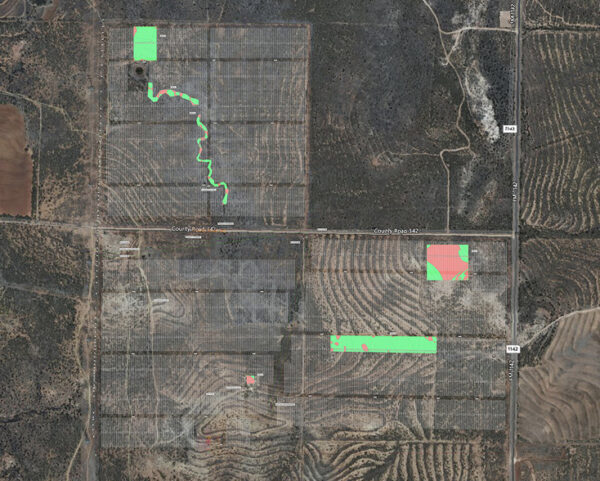
We modeled the construction sequence at Snyder as rigorously as the civil plans. Access routes were optimized for the movement of steel bundles, inverters, medium voltage (MV) equipment, and crane paths for handling large tracker components. When the construction path is engineered early, balance of system (BOS) design becomes cheaper and field execution becomes safer and faster.
BOS optimization
BOS optimization has traditionally been viewed as procurement-driven – find the lowest cost per watt – but CT Solar One showed the best BOS decisions come from engineering and procurement working as a single, integrated team.
Aligning DC feeder routes with the natural drainage corridors, for example, reduced trenching volumes – the amount of soil that must be excavated to open trenches for underground cables. By following the site’s natural pathways instead of cutting across slopes, we were able to shorten these trench runs and simplify restoration after construction.
Using constructability models to evaluate reel lengths, pulling tensions, and splicing points allowed us to eliminate unnecessary junction boxes and reduce total cable footage. These engineering-led decisions improved commercial outcomes more than pure price negotiation.
The core lesson is that BOS optimization is not a shopping exercise, it is a design discipline that touches geotechnical data, construction logistics, and risk management. Engineering and procurement cannot operate in silos if a project is to remain competitive.
Engineering decisions
The Inflation Reduction Act introduced a set of incentives, domestic-content rules, and bonus credits that influenced almost every engineering decision. As a policy framework it was expansive and transformative, encouraging US manufacturing while redirecting how projects are designed, procured, and optimized.
CT Solar One offered an example. Early in procurement, imported equipment presented attractive pricing. However, once we modeled the domestic-content scenarios and their interaction with long-term financing, the engineering path changed.
We ultimately opted for a fully domestic critical-path supply chain, involving four US manufacturers: FTC Solar supplied single-axis trackers with 100% of metallic components manufactured in Texas; WTEC supplied MV and DC cabling manufactured in Florida, enabling US-origin certification; TMEIC supplied utility-scale inverters manufactured in Texas; and SEG Solar provided high-efficiency PV modules manufactured in Texas.
This strategy influenced project engineering; cable routing, MV equipment pads, crane logistics, and even inverter pad grounding designs were adapted to match the dimensions, layout constraints, and documentation packages of these components. It was an engineering choice that supported domestic-content eligibility while maintaining schedule certainty and reducing supply-chain risk.The lesson is that procurement is no longer a tax conversation, it is an engineering conversation. Civil, electrical, and structural teams must understand US manufacturing pathways, because domestic-content eligibility depends not only on where components are made, but on how they are selected and installed. Knowing which materials qualify for bonus credits and how they must be treated in the field shapes foundation choices, wiring methods, procurement sequencing, and even construction tolerances. Domestic content is not something verified at the end of a project, it has to be engineered from the start.
About the author
 Fernando Queiroz is CEO and executive engineering director at Levona Renewables, where he leads the 1.6 GW CT Solar Platform in Snyder, Texas. He specializes in BOS optimization, tracker engineering and the integration of domestic-content and IRA-driven requirements into large-scale solar design and previously developed the HURAC-640 single-axis tracker in Brazil.
The views and opinions expressed in this article are the author’s own, and do not necessarily reflect those held by pv magazine.
This content is protected by copyright and may not be reused. If you want to cooperate with us and would like to reuse some of our content, please contact: editors@pv-magazine.com.




By submitting this form you agree to pv magazine using your data for the purposes of publishing your comment.
Your personal data will only be disclosed or otherwise transmitted to third parties for the purposes of spam filtering or if this is necessary for technical maintenance of the website. Any other transfer to third parties will not take place unless this is justified on the basis of applicable data protection regulations or if pv magazine is legally obliged to do so.
You may revoke this consent at any time with effect for the future, in which case your personal data will be deleted immediately. Otherwise, your data will be deleted if pv magazine has processed your request or the purpose of data storage is fulfilled.
Further information on data privacy can be found in our Data Protection Policy.