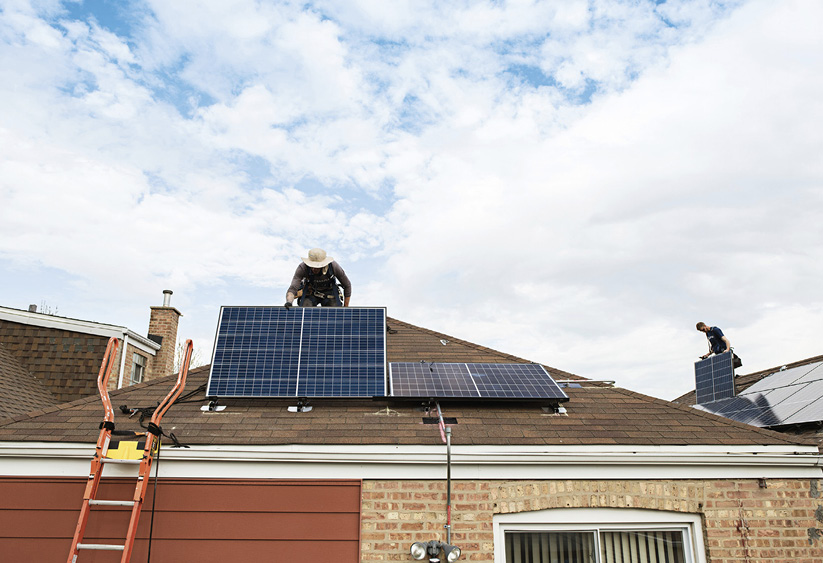





Fixed costs have pushed electricity bills higher in California, sparking debate over who pays their fair share.
The state’s investor-owned utility (IOU) model translates fixed costs such as investments in grid resilience into higher rates paid by households. Most fixed costs are recovered through volumetric, per-kilowatt hour charges. When fixed costs rise but are collected mostly through energy rates, per-kilowatt hour prices climb. Cost allocation becomes opaque.
There has been an attempt to quantify the fairness of cost allocation, but there is disagreement on the numbers. The California Public Advocates Office estimates that historically, net energy metering (NEM) resulted in higher bills for non-solar customers. This was calculated as equivalent to 16% to 23% added to their average electricity bills by the end of 2024.
The solar industry disputes this, arguing rooftop solar brings value to the grid due to deferred infrastructure upgrades, reduced transmission congestion, and avoided peak capacity costs – potentially generating a net benefit of approximately $1.5 billion.
The disagreement reveals the policy challenge: designing a compensation model that reflects the full value of distributed energy resources while maintaining equity and system efficiency.
Enter NEM 3.0
The California Public Utilities Commission (CPUC) introduced its third-generation net metering policy for solar – NEM 3.0 – in spring 2023 in a bid to correct perceived cost allocation failures of NEM 2.0. Households under NEM 3.0 contracts are not paid the full retail rate for electricity exported to the grid. They are instead paid credit based on the Avoided Cost Calculator (ACC) value, which is significantly lower than the retail rate. NEM 3.0 ACC compensation excludes consumers from most fixed grid costs, and regulatory modeling predicted the tariff would significantly mitigate the cost shift for new solar systems.
The policy has supported greater energy storage adoption. As of the first quarter of 2024, the percentage of battery energy storage systems (BESS) installed with new solar systems surged to over 60%. This aligns with the goal of incentivizing energy discharge during high-value evening hours, but has come at substantial cost. PV-only installations plummeted resulting in an estimated loss of 17,000 jobs. Interconnection data show monthly standalone PV applications dropped 77% after NEM 3.0 was introduced, while PV with energy storage applications rose 110% over the same period. These reforms have eased the cost-shift debate but, in combination with a new fixed charge for all consumers, have also slowed distributed solar deployment.
Fixed charge reform
The CPUC also adopted an income-graduated fixed charge in May 2024 – the commission’s second structural attempt to reform fixed cost recovery. The design shifts certain fixed grid costs into a monthly fee while reducing volumetric rates by $0.05/kWh to $0.07/kWh. The new charge is structured in tiers, approximately $24 per month for standard customers, with discounts for moderate-income ($12 per month) and low-income ($6 per month) customers.
The proposal has received some support due to its potential to reduce bills for low-income families and encourage electrification. Yet, controversy remains. There are two main conflicts: The disproportionate burden placed on very low-usage households, and the compounded financial pressure on the solar industry when combined with NEM 3.0. This reform is a critical test of whether California can achieve cost equity within its existing utility framework.
Diversifying financing
Despite reform, the core of the problem remains untouched. Why are fixed grid costs rising so fast?
Financing is a large part of the answer. In the IOU system, essential public-safety spending such as wildfire mitigation is treated as capital investment – earning a regulated return on equity, often around 9% to 10.5%.
Ratepayers therefore pay for both the infrastructure and the shareholder return. Lowering the cost of capital for these investments via public or quasi-public debt could reduce bills, delivering the same upgrades without embedding an equity profit premium in the fixed costs paid by consumers.
There are examples to draw on. California already offers wildfire securitization bonds as a tool to manage risk and smooth costs. IOUs issue recovery bonds that are backed by a long-term surcharge on all customer bills.
This spreads wildfire liabilities across a broad base of bill payers, lowering financing costs. But this only smooths the repayment of existing liabilities and does not remove the incentive for the IOU to increase profit-earning capital spending.
To truly lower system costs, California needs new models. New York’s Reforming the Energy Vision policy initiative demonstrates one approach. The state has established public financing tools such as the $5.3 billion Clean Energy Fund and the NY Green Bank. The Green Bank uses public capital as a risk-bearing lever to mobilize lower-cost private financing for distributed energy resources. This eases pressure on bills without relying on the IOU’s expensive profit model.
Fiscal innovation
California’s grid dilemma reflects a financing failure. NEM 3.0 and the fixed charge are necessary, market-driven attempts to improve equity and price signals, but they cannot resolve the deeper problems of increasing costs and risk socialization in the IOU system. California targets the drivers of cost growth. Policymakers should make use of securitization to smooth large costs, and they should expand low-cost public financing so that grid investments are not funded through high-cost equity financing. The grid of the future needs more distributed systems and that requires a just, forward-looking financial and regulatory framework that meets climate goals without sacrificing affordability. Yujia Han
About the author
 Yujia Han is a Clean Energy Leadership Institute (CELI) 2025 DC fellow, specializing in wind and solar energy development. She previously worked with the International Energy Agency, where she contributed to international initiatives on renewable energy development and industrial decarbonization.
The views and opinions expressed in this article are the author’s own, and do not necessarily reflect those held by pv magazine.
This content is protected by copyright and may not be reused. If you want to cooperate with us and would like to reuse some of our content, please contact: editors@pv-magazine.com.



Thanks for making a complex issue a lot more understandable!