




For most of solar’s modern history, system performance modeling followed a simple rule: when the sun is shining, solar produces. Inverters operated near their optimal power range, exported excess energy to the grid, and financial projections assumed relatively straightforward conversion losses.
That paradigm no longer holds.
As residential solar markets rapidly transition to solar-plus-storage—driven by utilities increasingly penalizing exports—systems are being operated in fundamentally different ways. Yet many financial models, underwriting assumptions, and performance guarantees still reflect a 1:1 net-energy metering and a PV only world. The result is a growing mismatch between modeled performance and real-world outcomes, with meaningful implications for long-term return on investment (ROI).
From Export Maximization to Self-Consumption Optimization
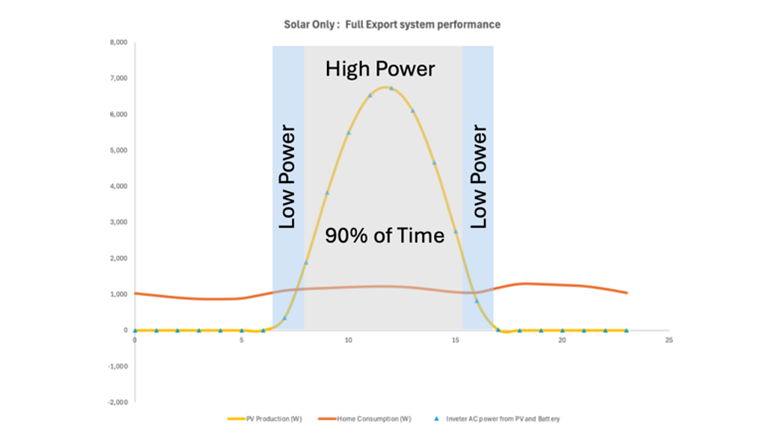
Historically, net metering tariffs rewarded production regardless of timing, and inverter efficiency curves were designed around daytime, mid-power operation. Solar value was maximized by exporting energy and avoiding the expense of storage. Energy flowed directly from panels to the grid or home loads, and systems rarely spent significant time operating at very low output levels.
Today’s economics are inverted.
In states like California, Hawaii, Arizona, Nevada, and New York—and increasingly across much of the U.S.—exported energy is worth far less than energy purchased from the utility. In some markets, exports are credited at wholesale rates that can be two to three times lower than retail electricity prices. As a result, batteries are no longer a “nice to have” backup feature; they are an economic necessity configured to maximize the self-consumption of solar energy.
This shift changes not only where energy flows, but how equipment operates.
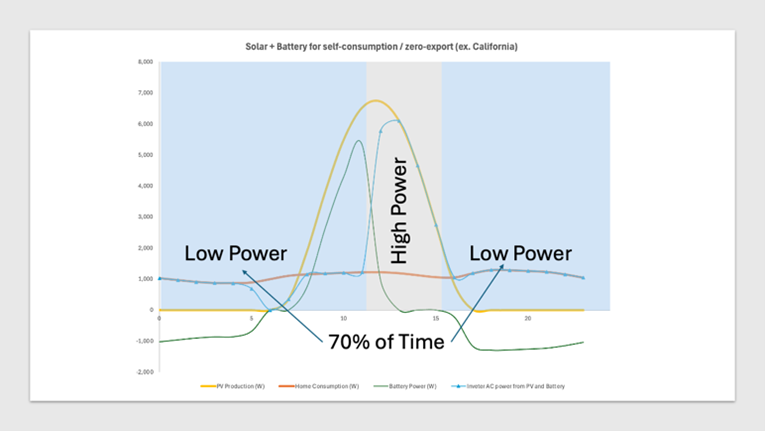
Instead of pushing energy out quickly, systems now prioritize keeping energy on site. Batteries charge to avoid solar export, discharge slowly over long periods, and are likely to cycle more frequently. Inverters spend far more time operating at low power levels under self-consumption-focused solar-plus-storage operation–conditions that were once rare but are now common.
Why Legacy Models Fall Short
National laboratory research, including work from the National Renewable Energy Laboratory, has begun to explore how behind-the-meter storage and self-consumption strategies alter system operating profiles. However, much of the industry’s widely used production and financial modeling infrastructure and methodologies still reflect assumptions developed for PV-only or export-optimized systems (e.g. time-of-use operation), rather than the extended low-power and high-throughput operation now common in storage-heavy designs where self-consumption delivers the highest value. These operating conditions expose different efficiency weaknesses depending on system architecture, rather than a single universal loss mechanism.
In reality, modern solar-plus-storage systems experience compounded losses across multiple steps:
- Energy routed into batteries instead of directly to loads – especially in AC-coupled systems, where multiple DC→AC→DC→AC conversion steps and clipping can result in disproportionately high energy losses. DC-coupled architectures, which minimize conversions with a single DC→AC step, can mitigate some of these losses.
- Parasitic losses from batteries and inverters consuming energy just to remain operational
- Prolonged inverter operation at low power levels, which can drive disproportionately high losses in inverters not optimized for efficient low-power performance
Individually, some losses may appear marginal, but in many system architectures at least one dominant loss mechanism is not. Different designs shift inefficiencies to different parts of the system—such as AC-coupling losses, low-power inverter inefficiency, or high self-consumption overhead—making it difficult for any single architecture to maintain high efficiency across all operating modes. Collectively, these losses can materially reduce annual energy delivered at the customer meter.
What has become increasingly clear is that not all inverter and storage designs behave the same way under prolonged low-power operation — and differences that appear negligible at nameplate ratings can become material when systems spend most of their lives operating well below peak output. Efficiency curves that look similar at nameplate ratings can diverge meaningfully when systems spend most of their operating life charging, discharging, or idling at a fraction of rated output — precisely the conditions created by prioritizing self-consumption. In these conditions, some systems retain efficiency far better than others.
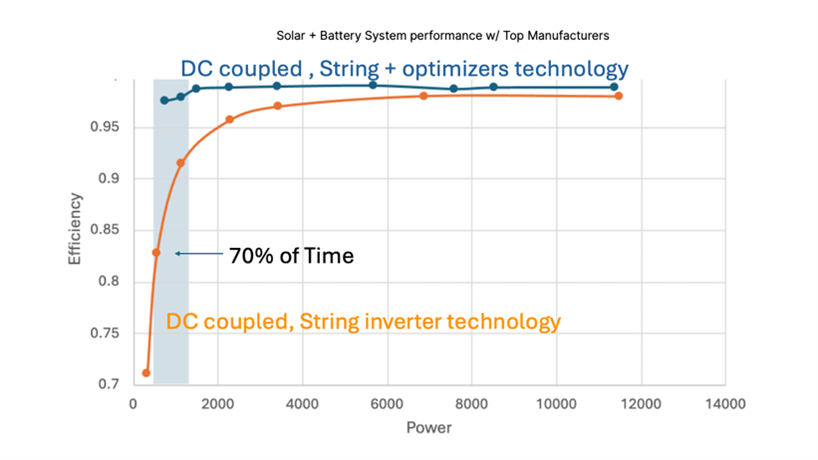
[slide 3) Figure 3: System efficiency curves under varying power levels. DC-coupled architectures with optimizers maintain higher efficiency during the extended low-power operation typical of self-consumption strategies.
Importantly, this does not mean all solar-plus-storage systems are destined to underperform. Some technologies and architectures are better suited to sustained low-power, self-consumption-heavy operation than others. As a result, asset owners, installers, and financiers should scrutinize not just peak specifications, but how different system designs perform across real-world operating conditions.
Why Financiers Should Pay Attention
For tax equity, cash equity, and especially debt investors, this issue is not academic. Many residential portfolios rely on long-term production estimates to support performance guarantees, debt service coverage ratios, and investor returns.
If a system is modeled using legacy assumptions but operated under modern self-consumption strategies, the asset may systematically underperform projections, even if all equipment functions as specified.
This is particularly concerning in an industry where margins are already thin. Performance guarantees paid to homeowners or commercial off-takers come directly out of operating cash flow. Underperformance increases operational risk, weakens portfolio economics, and can ripple through the capital stack.
Importantly, this risk does not depend solely on what equipment is installed—but on how it is used.
As self-consumption-heavy operation becomes more common, some TPO asset owners may have unseen impacts of efficiency losses. Gaps between modeled and delivered energy may only amount to a few percentage points annually, but those gaps compound meaningfully over a 25- to 35-year asset life. Even modest deviations can translate into significant financial exposure when applied across large portfolios or long-term performance guarantees with large concentrations of assets in export penalized markets.
The Customer Perspective Has Changed Too
Recent industry reporting underscores this shift. While backup power remains an important selling point, homeowners increasingly cite bill savings and energy self-supply as their primary motivations for installing batteries.
In unfavorable export markets, published market analyses show storage attachment rates exceeding 75%, driven largely by economics rather than resilience.
This means systems are intentionally being operated in ways that legacy models never anticipated. Batteries are stretched across long discharge windows throughout the night instead of discharging their energy in a few peak hours in the evening under TOU tariffs. Exports are now avoided whenever possible. Equipment is optimized for economics, not nameplate performance.
In a market that relies heavily on referrals and peer validation, underdelivering on promised bill savings has downstream consequences. Unhappy customers not only dampen referral-driven growth, but can also increase payment defaults, directly impacting portfolio performance for TPO providers and financiers.
A Familiar Industry Inflection Point
Solar has faced similar moments before. A decade ago, financiers scrutinized module degradation rates down to a few tenths of a percent, recognizing how small annual differences could materially impact lifetime returns and valuations.
Today’s challenge is analogous. The efficiency impacts of self-consumption-heavy operation may exceed the financial importance of degradation assumptions. Energy models typically are focused on estimating solar generation and do not typically consider the delivery path in this operating mode.
Updating the Playbook
As more markets and regions transition to unfavorable export tariffs, storage and self-consumption are essential strategies for solar’s continued growth in markets with high renewable penetration (a driver for unfavorable export tariffs).
Stakeholders across the value chain should consider updating their assumptions:
- Models should reflect real operating profiles, not legacy unconstrained export or TOU behavior
- Performance guarantees should align with actual system use cases
- System designs may need to balance power ratings, storage capacity, and real-world, low-power operating efficiency, not just peak specifications
- Transparency with homeowners and investors is essential
In response, several technology providers have begun publishing technical guidance intended to help financiers and developers better quantify energy flows and efficiency impacts in storage-heavy operating modes.
Accurately accounting for energy flows before and after storage, including excess conversion losses introduced by system architecture, as well as system efficiency during extended low-power operation, is increasingly essential for understanding true system value in self-consumption-driven markets.
Ignoring these shifts risks a future where assets consistently underperform expectations, not because the hardware failed, but because the modeling methodologies didn’t keep pace with the market.
As solar-plus-storage becomes the default rather than the exception, success will depend less on installed capacity and more on accurately accounting for how energy actually flows. The era of “suns out, guns out” is over. The era of self-consumption economics has arrived, and the industry’s models need to reflect it.
 Author Bio: Sean McPherson, Founder of Full Stack Energy Advisors, is a renewable energy veteran with over 20 years of technical and commercial experience, largely focused on distributed generation. He has led technical diligence for over $7 billion in structured finance across residential, commercial, and utility-scale projects. His expertise spans the product lifecycle, from hardware evaluation, energy modeling, system design, and construction to asset management and performance analytics for distributed portfolios of up to 650,000 assets. Sean is a UC San Diego Mechanical Engineering graduate and former NABCEP-certified professional, Full Stack Energy Advisors specializes in technical risk management, portfolio asset management, product strategy, and hardware evaluation..
The views and opinions expressed in this article are the author’s own, and do not necessarily reflect those held by pv magazine.
This content is protected by copyright and may not be reused. If you want to cooperate with us and would like to reuse some of our content, please contact: editors@pv-magazine.com.




Solar plus storage should be utility managed and not homeowner financed and maintained. The 1.2 million homes plus all the tracking solar and wind should feed “one grid”, and all the battery storage should be on well managed utility grade storage for everyone to use. Treating grid battery storage, a “Peaker plant” statewide, would make the system more efficient and actually save every consumer money. California has already adopted NEM3.0 where 75% of the rooftop energy is given to the utility for FREE. That energy is sold and pocketed by the utility as profit. Why does the CPUC allow this instead of allocating part of the FREE money to storage construction and maintenance? California is a big state with many microclimates. The southern California desert solar farms and mountain pass turbines create energy that is distributed throughout the state so cloudy coastal areas can be powered by the sun and wind. More localized storage systems could take the excess energy and store it and release it during low output periods like turning on a Peaker plant. Residential storge system cost five to seven times what a large utility storge system costs to install and maintain for resulting kilowatt hour capacity. Residential solar does not supply enough in winter to even charge the home installed batteries in Northern California so the batteries lay idle for 5 to 6 months out of the year. Not very efficient for the expected 14-year life of the battery system.
Yes good information. I added a AC coupled battery with manufacturing spec round trip efficiency of about 94%. BUT real life data showed that for every 10kW that went into the battery, only about 8 came out. Well below the stated 94%. So since I still have net metering I changed the batteries for back up only. Idle losses are a more modest 3%.