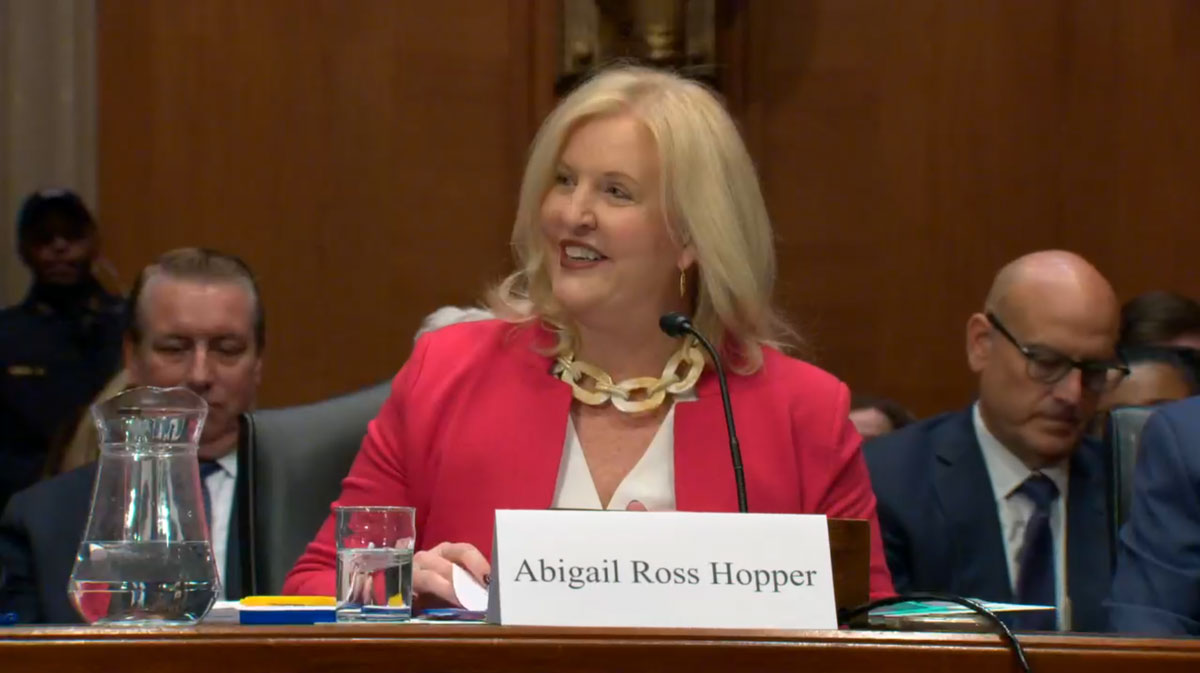





The tone of Wednesday’s Senate Environment and Public Works (EPW) Committee hearing was mostly one of alignment between industry representatives and lawmakers.
With the U.S. energy grid in desperate need of new energy projects to address affordability and skyrocketing demand from data centers, Senators Shelley Moore Capito (R-WV) and Sheldon Whitehouse (D-RI) led a discussion that revealed many areas of consensus, with Capito calling attention to “the pressing need to act this year on reforms and what we will leave on the table if we are unsuccessful.”
The Committee is the first stopping point in the Senate for the SPEED Act (H. Res 4776) and PERMIT Act (H. Res 3898), after both laws were passed by the House of Representatives in late 2025. The Senators on the EPW Committee must now make their recommendations on the laws before they can move forward.
The industry experts called to testify before the committee were:
- Brendan Bechtel, chair of the smart regulation committee for the Business Roundtable
- Brent Booker, general president of the Laborers’ International Union of North America (LIUNA)
- Dustin Meyer, senior vice president of policy, economics and regulatory affairs for the American Petroleum Institute (API)
- Abigail Ross Hopper, president and CEO of the Solar Energy Industries Association (SEIA)
- David S. Terry, president of the National Association of State Energy Officials (NASEO)
Among the ideas that all panelists seemed to agree upon were the need for efficient, predictable regulatory frameworks and technology-neutral permitting that allows energy resources to move more quickly through the permitting process and remain final once approved.
A “trust problem” in the executive branch
The hearing took place against a backdrop of aggressive executive actions that have rattled the renewable energy industry.
In late December 2025, the administration issued stop-work orders for five major offshore wind projects citing “national security risks” just days before Christmas.
Booker decried those orders, noting his organization’s members were “on the water… building offshore wind for Revolution off the coast of Rhode Island” at the time of the stop-work orders, and that those workers “didn’t get a paycheck on December 30th.”
While courts have since granted preliminary injunctions allowing some work to resume, the volatility has spooked investors. Senator Whitehouse did not mince words, calling the administration’s justification for the blockades “lawless, irrational, and unpredictable,” noting that four federal judges had already rejected the national security pretext.
“This is not Democrat versus Republican.” Whitehouse said, “This is legislative versus executive. An age-old drama in this case with an executive that won’t honor its constitutional duty to faithfully execute the law.”
Later in the hearing, Wyoming Senator Cynthia Lummis echoed these statements in a retort to Senator Ed Markey of Massachusetts (who partially used his time to excoriate President Trump for what he called a “war on American clean energy), saying “where you said ‘left,’ we could put ‘right.’ Where you said ‘right,’ we could put ‘left.’ Where you said ‘Trump,’ we could put Biden.’, where you said ‘Biden,’ we could put Trump.’ adding “What we do need is some certainty.”
This shared experience of executive whiplash appears to be driving some hope for a durable legislative fix. “Our goals share more in common than most would admit,” Chairman Capito stated, calling for legislation that is “project neutral” and creates “predictability, consistency, and finality”.
SEIA president Hopper weighs in
At the center of the testimony was Abigail Ross Hopper, outgoing president and CEO of the Solar Energy Industries Association (SEIA), who detailed the chilling effect of recent Trump administration actions on the solar sector. Incoming interim president Darren Van’t Hof, who will take over after Hopper leaves office on Friday, also attended the hearing.
Hopper described a regulatory landscape where valid permits are effectively nullified by political interference, specifically citing a July 15, 2025, Department of the Interior (DOI) memo that introduced what she described as “68 new layers of red tape” for solar projects.
According to Hopper, these new hurdles have effectively amounted to a “moratorium on solar,” requiring secretarial-level approval for even minor project reviews and leaving gigawatts of capacity paralyzed in a bureaucratic black box.
SEIA’s message to the Senators was clear: The solar industry believes permitting reform must address the multi-agency federal solar moratorium and protect projects with existing permits, establish certainty, shorten permitting timelines and accelerate the build-out of transmission capacity.
“Once a project receives a permit, that permit should be honored,” Hopper said. “The finality of final decisions and permits is critical.”
The role of solar in the “AI arms race”
For the solar industry, the stakes of this legislative push go beyond just project survival. Hopper testified that political roadblocks are endangering 70 GW of solar and 42 GW of battery storage, projects which she says represent 43% of all planned new power capacity on the grid.
Later, Hopper asserted that solar and storage are the only technologies capable of deploying fast enough to meet the crushing load growth from artificial intelligence and domestic manufacturing, with 250 gigawatts of solar capacity forecast through 2030 — but only if it can get through the permitting process.
“Solar and storage can meet that timeline, complementing natural gas and nuclear projects that typically take longer,” Hopper said, warning that uncertainty is driving up capital costs and delaying the very electrons needed to win the global AI race.
The economic fallout is already measurable, asserted Bechtel, who cited a McKinsey study that shows how $1.5 trillion in potential investments are currently stalled in the permitting queue, with delays costing the U.S. economy billions annually..
“Certainty is the key.” Hopper said at the conclusion of her opening statement. “The time to act is now.”
What’s next?
The committee is now tasked with deciding whether, and how, it will take action on the SPEED and PERMIT Acts — and indeed whether any changes Congress could make would have an effect on the kinds of actions Executive branches run by both major parties have used to halt energy project permitting in recent years.
The full video recording of the hearing and testimony of the panel can be found on the Senate EPW Committee website.
This content is protected by copyright and may not be reused. If you want to cooperate with us and would like to reuse some of our content, please contact: editors@pv-magazine.com.




By submitting this form you agree to pv magazine using your data for the purposes of publishing your comment.
Your personal data will only be disclosed or otherwise transmitted to third parties for the purposes of spam filtering or if this is necessary for technical maintenance of the website. Any other transfer to third parties will not take place unless this is justified on the basis of applicable data protection regulations or if pv magazine is legally obliged to do so.
You may revoke this consent at any time with effect for the future, in which case your personal data will be deleted immediately. Otherwise, your data will be deleted if pv magazine has processed your request or the purpose of data storage is fulfilled.
Further information on data privacy can be found in our Data Protection Policy.