




Despite political headwinds, policy changes, and uncertainty, solar energy has emerged as California’s leading source of electricity. As of Q2 this year, it was one of the top five states with the most installed solar capacity. Solar installations in the commercial sector also registered a 27% increase compared to Q2 in 2024, thanks to the state’s pipeline of NEM 2.0 installations.
The fate of the renewable energy sector in the US may be uncertain, but California’s interest in solar remains strong. Priorities have shifted, with consumers focusing more on on-site, smart installations. There’s also an increasing demand for combining solar power generation with long-term storage.
Despite a largely positive outlook, challenges exist.
For solar contractors, the immediate roadblock is not demand generation. It’s navigating the complex landscape of changing consumer demands, a dated approach to installation, and ever-changing policy regulations. Achieving the perfect balance while turning a profit is nearly impossible without innovation.
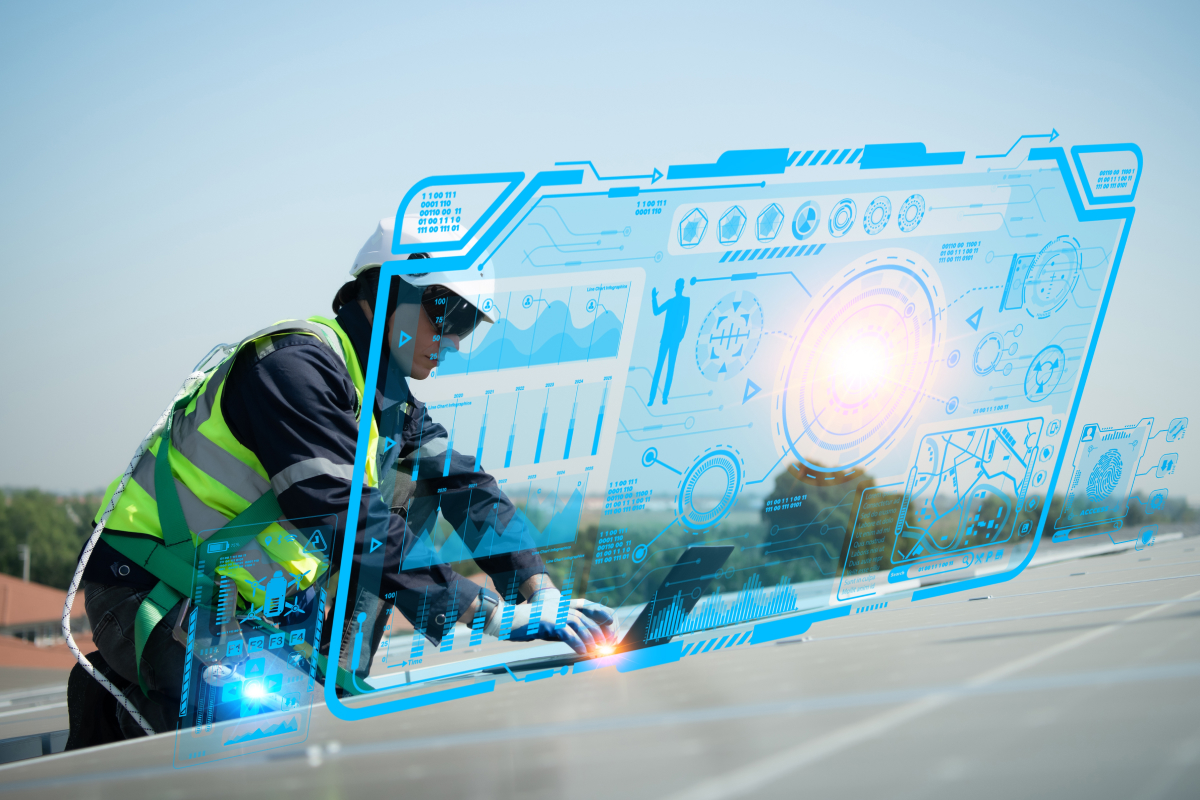
For AMECO Solar, the nexus between renewable energy contracting and Artificial Intelligence (AI) was the answer to these challenges. Before getting into the deep, let’s understand the root cause of these problems.
The Current State of Affairs
The complexities of the solar energy value chain are plenty.
- The current infrastructure is inefficient and unscalable. It is not easily adaptable and, therefore, just one mistake away from crumbling.
- Design and maintenance bottlenecks impact everything from grid stability to client servicing.
- Consumers are cautious and harder to convince than ever before. Outdated sales enablement approaches without proof of concept negatively affect conversion rates.
These problems are not unique; they apply to solar service providers running a business in California and even the country at large. For AMECO, the buck did not stop at identifying the problems. It initiated the need for a rethink.
How AMECO Used AI to Address Industry Challenges
The traditional process of solar installation was labor and time-intensive. Matters of energy requirement calculations, roof site inspection, and layout design heavily relied on highly skilled labor and time.
Until a few years ago, manual handling and management were the norm for solar contracting. Given the prevalent socio-economic circumstances, that approach worked.
But, since then, times have changed.
Today’s consumers, whether residential or commercial, are seeking foolproof solar solutions. The focus has shifted from offloading power requirements to solar energy. Increasing grid independence, improving capacity generation, and maximizing financial gains are their priority.
In order to cater to these demands, AMECO had to focus on providing reliable and future-proof solar solutions that were guaranteed to yield a good ROI. Achieving that goal required a procedural overhaul.
From energy calculations to roof inspection, designing, and fitting — every step of the installation process needed to be optimized for accuracy and efficiency gains.
That’s why, despite more than 50 years of experience in the industry, AMECO felt the need to innovate its approach.
So, it switched to AI-first solutions to address two components of its methodology. These were:
Design and Engineering
AMECO integrated AI at the roots — starting with site inspection and solar panel system design.
The implementation of AI in initial site inspection helped automate an otherwise manual and time-consuming process. Of course, the accuracy of deductions during preliminary inspection improved, too.
By analyzing a database of location-specific satellite, LiDAR, drone, and other types of imagery data, AI algorithms performed precise shading analysis. It offered insights into the optimal placement of solar panels to minimize energy loss due to surrounding obstructions.
Precise shading analysis offered other long-term benefits, too.
Prevention hotspots were one such thing that helped prolong the lifespan of solar panels. For discerning customers who wanted to maximize their solar investment, this factor alone won brownie points.
Another immediate benefit of AI implementation was in system design.
Thanks to its capacity for studying historical data and performing roof inspections, AI solutions were able to create solar panel designs that are customized for each roof type. That bespoke service was an undeniable value-add in a difficult market.
Overall, AI integration in engineering addressed design bottlenecks, expedited the installation process, and improved the power generation efficiency of solar panels.
This new approach proved time, effort, and resource efficient.
Sales Proposals
Beyond design improvements, AMECO also utilized AI and Machine Learning (ML) to generate custom proposals for clients.
The switch simplified the energy requirement calculations, reducing the manual load on the team. Through a comparative analysis of bills, vis-à-vis solar systems fitted with storage or without it, customers were empowered to make better decisions.
Instead of performing complicated math, experts focused on data-driven consulting that improved conversion rates. It also boosted customer satisfaction.
AMECO’s clever implementation of AI is proof that this nexus has the potential to optimize the supply chain for productivity and efficiency gains.
How Solar Contractors Can Benefit from AI
Solar contractors operating their business in California can take a leaf out of AMECO’s book and look forward to implementing AI-based solutions.
Of course, the applications will vary. The good thing is that AI can be used to improve many parts of the solar service value chain. So, solutions can be chosen in accordance with the contractor’s biggest challenge and priorities.
AI in solar is not limited to site inspection, system design, or custom proposal creation. It includes a gamut of applications, one of the most common (and useful) being predictive maintenance.
Predictive maintenance has applications in residential and commercial solar setups. It can be used to detect possible system failures ahead of time, preventing unprecedented downtime and maintenance costs.
For residential users, predictive maintenance can help with solar panel cleaning reminders, battery/inverter storage health monitoring, etc.
As their service provider, solar contractors can use predictive maintenance to provide top-notch customer service. Beyond predictive maintenance, AI-based solutions can have other far-reaching implications.
Widespread democratization of the technology has already made it accessible for use. There’s no time better than now to make the switch.